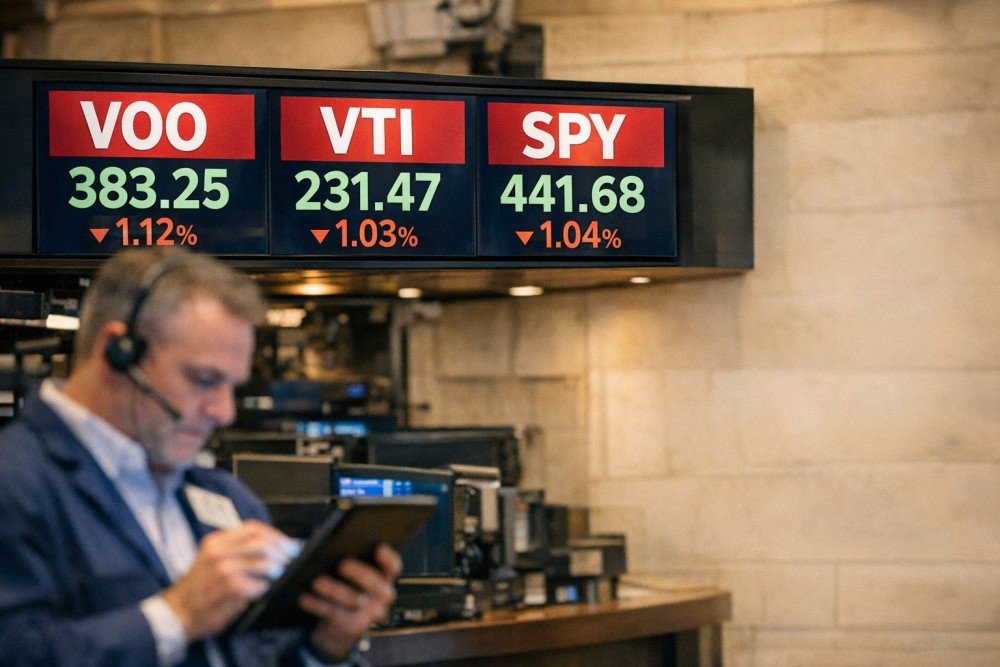
The VOO vs VTI vs SPY debate ends for most investors once they see the real cost data, and the best S&P 500 ETF in 2026 depends less on returns than on how you plan to use it. All three track overlapping slices of the US equity market, yet they differ on fees, structure, and trading mechanics in ways that compound over decades.
This core ETF comparison breaks down where each fund wins and which one deserves the anchor slot in your portfolio.
Expense Ratios, AUM, and Liquidity Compared
Fees are the first filter. VOO and VTI each charge a 0.03% expense ratio, while SPY charges 0.0945%, roughly triple the cost.
On a $100,000 position held for 30 years, that gap compounds into thousands of dollars of foregone returns before any market movement.
| Metric | VOO | VTI | SPY |
|---|
| Expense ratio | 0.03% | 0.03% | 0.0945% |
| AUM (Apr 2026) | ~$430B | ~$380B | ~$723B |
| Index tracked | S&P 500 | CRSP US Total Market | S&P 500 |
| Structure | Open-end ETF | Open-end ETF | Unit investment trust |
According to State Street Global Advisors, SPY manages over $723 billion in assets, making it the most liquid S&P 500 product on earth.
That liquidity shows up in penny-wide bid-ask spreads, ideal for active traders moving large size quickly.
Holdings Overlap and Tracking Error
VOO and SPY are effectively the same fund in different wrappers. Both hold the 500 S&P 500 constituents in matching weights, so their holdings overlap is close to 100%.
VTI is the outlier. It holds roughly 3,500 US stocks across large, mid, and small caps, tracking the CRSP US Total Market Index.
According to Optimized Portfolio, VOO represents about 82% of VTI by weight, meaning VOO is essentially a subset nested inside VTI's broader portfolio.
Tracking error is negligible for all three, consistently under 0.05% annualized. Where VTI diverges from the S&P 500 family, it does so deliberately by adding small and mid-cap exposure that VOO and SPY cannot offer.
Ready to build a core position with fractional ETF investing? Start your DCA plan with Gotrade.
Tax Efficiency and Distribution Cadence
Structure matters more than most investors realize. VOO and VTI benefit from Vanguard's patented share-class system, which uses in-kind redemptions to flush out capital gains before they hit shareholders.
Neither fund has distributed a capital gain since inception, a track record few ETFs match.
SPY is a unit investment trust, an older structure that cannot reinvest dividends internally and has less flexibility on in-kind redemptions. It still has not paid a meaningful capital gains distribution in recent memory, but the structural ceiling is lower.
All three pay quarterly dividends, with yields hovering around 1.2% for VOO and VTI and similar for SPY. VOO distributes essentially 100% qualified dividends, a small tax advantage over VTI's roughly 95% qualified ratio.
For more context on the ETF wrapper itself, see our ETF beginner guide.
Which One Is Best for Your Use Case
Picking the right core ETF comes down to how cash flows into your account and how often you trade.
1. DCA investor with small regular contributions
VOO is the default winner. The 0.03% expense ratio minimizes drag, the quarterly distributions are tax-efficient, and fractional share support on modern brokerages lets you deploy every dollar.
Automating $50 or $100 weekly into VOO gives you S&P 500 exposure at essentially zero friction.
2. Lump-sum long-term holder
VOO or VTI both work here, so choose based on market-cap appetite. Pick VOO if you want pure large-cap S&P 500 exposure and plan to add separate small-cap tilts later.
Pick VTI if you want the entire US market in one ticker and never want to rebalance across cap sizes. For timing considerations, our lump-sum vs DCA breakdown covers the evidence.
3. Active trader or options user
SPY is the only serious choice. The $723B AUM and 80M+ daily share volume produce the tightest spreads, and SPY has the deepest options market of any US ETF.
If you run covered calls, spreads, or weekly options around earnings, that liquidity is worth the 0.06% fee premium over VOO.
Conclusion
The VOO vs VTI vs SPY question has a cleaner answer than most investors expect. SPY is built for traders and options volume, VTI is built for total-market purists, and VOO is the low-cost S&P 500 anchor for everyone in between.
For the average long-term investor building a core position, VOO is the best S&P 500 ETF in 2026, full stop. The fee advantage over SPY compounds for decades, and the Vanguard share-class structure keeps tax drag minimal.
Ready to put this into action? Open a Gotrade account and start a core VOO position from US$1 with fractional shares, or automate your DCA plan so every paycheck builds the same S&P 500 exposure NerdWallet's top readers have been using for years.
FAQ
Can I own VOO and VTI together?
Yes, but it is redundant because VOO makes up about 82% of VTI, so pick one as your core.
Is SPY worth the higher fee?
Only for active traders and options users who need the deepest liquidity and tightest spreads.
Do these ETFs pay dividends monthly?
No, all three pay quarterly dividends with yields around 1.2% in most market conditions.
Can I buy fractional shares of VOO on Gotrade?
Yes, Gotrade supports fractional share investing starting at US$1 for VOO, VTI, and SPY.