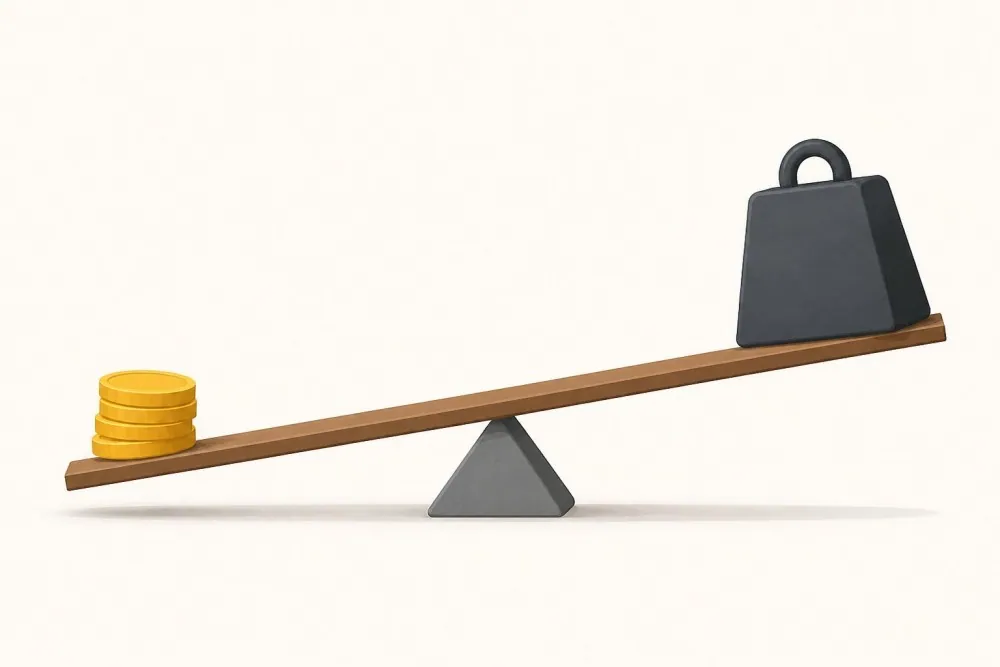
Leverage means using borrowed money or a financial product to control a bigger position than your own cash allows.
This guide runs one $1,000 example with and without 2:1 leverage, shows how interest and a deep enough price drop can leave you owing more than you put in, and explains leverage ratios, margin calls, leveraged ETFs, options, futures and CFDs.
Leverage means using borrowed money to invest more than you actually have. It is one of the ways investors can buy shares or other assets when they don't have the cash on them. In this article, we will discuss how it works, the risks, and examples. You can also try simulating leverages using our calculator.
Leverage Meaning
Leverage means using borrowed money or financial tools to control a bigger position than your own cash would allow. In finance, there are two meanings to this word:
In trading: this means borrowing from a broker (margin) or using derivatives like futures, options, and CFDs to get more assets.
In business: when a company is using debt to fund growth instead of only its own money.
The idea of leverage is funding your investment with borrowed money to make the position bigger, which means higher potential reward and also higher risk.
Example: Say, you have $1,000 of your own money. You want to buy a stock which trades at $50. These are leverage scenarios showing how many your potential gain and losses for the amount of shares you buy.
1. Without leverage
You buy 20 shares at $50 ($1,000). You don't borrow any money here, all is your own.
Price move
New price
Your holding
Gain/loss
Return on your $1,000
+20%
$60
$1,200
+$200
+20%
−20%
$40
$800
−$200
−20%
This is pretty much a standard trading. Your return matches the asset’s move, and the absolute worst case is losing the $1,000 you put in.
In this case, you borrow another $1,000 from your broker besides your own $1,000. Then you buy 40 shares ($2,000), so you control twice as much as you own. The same ±20% move now becomes about ±40% on your own money.
Price move
New price
Value of 40 shares
Repay loan
Your equity
Return on your $1,000
+20%
$60
$2,400
−$1,000
$1,400
+40%
−20%
$40
$1,600
−$1,000
$600
−40%
This example ignores loan interest, but a real loan will charge you interest, no matter whether you win or lose. For example, if the margin rate is 8% a year and you hold for one year, then the interest on the $1,000 loan is $80.
Scenario
Before interest
Interest
After interest
Real return
+20% move
+$400 (+40%)
−$80
+$320
+32%
−20% move
−$400 (−40%)
−$80
−$480
−48%
Interest will hit your profit, and still charge you when you lose value. The +40% gain becomes +32%, and the −40% loss becomes −48%. The longer you hold, the more interest adds up. So, a leverage needs the asset to rise enough to cover the loan’s cost before it becomes profitable.
3. When the loss exceeds what you put in
Your equity is what’s left after repaying the loan: 40 shares × price − $1,000. Watch it fall as the price drops:
Price
Drop from $50
Value of 40 shares
Loan
Your equity
Result on your $1,000
$40
−20%
$1,600
$1,000
$600
−40%
$25
−50%
$1,000
$1,000
$0
−100%
$15
−70%
$600
$1,000
−$400
−140%
Since your deposit is $1,000 and you're using $2,000 in total, a 50% drop means your deposit is wiped out. Your $1,000 loan will have interest, which means you are in the negative now.
When your position fall below 50%, you basically owe your broker money. In this case, when your stock price drops from $50 to $15, the total value drops from $2,000 to $600. The $1,000 loss comes from your money, and you still owe the remaining $400.
In practice, you are most likely be forced out earlier. Brokers require a minimum equity cushion, called the maintenance requirement. If your equity falls below it, you get a "margin call" and may be forced to sell. FINRA Rule 4210 sets a minimum maintenance requirement of 25%, and many brokers set it higher. So, a call would come around $33 per share, or about a 33% drop. Fast-moving markets can gap past that point before you can react, which is how losses end up beyond your deposit. The SEC also warns that you can lose your money fast and with no notice.
The prices, rates and holding period here are illustrative, not predictions or advice. Margin terms differ by broker.
Leverage ratios explained (2:1, 5:1, 1:30, 1:100)
Leverage ratios show how much exposure you get for each unit of your own money. Keep in mind that the notation is not always consistent, for example, 2:1 and 1:30 are written in opposite orders, but both mean the same thing. Your money is written as the small part, and the position is the big part.
How to read them
2:1 means a position worth 2x your money. $1,000 controls $2,000.
5:1 means $1,000 controls $5,000.
1:30 means $1,000 controls $30,000.
1:100 means $1,000 controls $100,000, and so on.
The Ratio Effect
Ratio
Margin needed
Price move that wipes out your stake
2:1
50%
About 50%
5:1
20%
About 20%
1:30
About 3.3%
About 3.3%
1:100
1%
About 1%
Note: Move that wipes out your stake ≈ 1 ÷ leverage, before interest, fees and spreads
Example at 1:100 ratio: you put up $1,000 and control $100,000. A 1% move is $1,000, so a 1% drop erases everything. We can imagine that prices can move 1% within a day or two, and in reality, your broker will usually close the position before you reach zero.
Which ratio do people use?
2:1 is the standard US stock margin account. The Federal Reserve’s Regulation T lets you borrow up to 50% of the purchase price.
4:1 is the intraday limit for US pattern day traders, who can trade up to four times their maintenance margin excess during the day under FINRA’s day-trading rules.
5:1 is the cap on CFDs on individual shares for retail traders in the UK and EU.
1:30 is the cap on major currency pairs for retail traders in the UK and EU. The European Securities and Markets Authority (ESMA) set these limits for the EU in 2018 after finding that 74% to 89% of retail CFD accounts typically lost money, and the UK’s Financial Conduct Authority kept the same caps. The same rules require brokers to close a retail position once your funds fall to half of the required margin.
1:100 and higher are common with offshore or less strictly regulated brokers, which are not bound by these caps.
Remember: a higher ratio does not make a trade more likely to work in your favor, but it can make you lose more money quicker. You can use our leverage simulator below to get a better picture.
Leverage Simulator
Leverage simulator
Leverage vs Margin
You will hear the term "margin" whenever talking about leverage. To simplify, think about buying a stock like buying a house with mortgage. You put a down payment, get the stock, and pay the rest to your broker later.
Margin is your down payment. It’s the money you actually put up in front, and the amount your broker holds as security.
Leverage is the price of the house compared to your down payment. It’s the multiplier on your exposure.
So, if you put up $1,000 of margin and control $10,000 of an asset, it means your leverage is 10x ($10,000 ÷ $1,000). A 5% margin requirement equals 20x leverage, and a 10% requirement equals 10x.
What is a margin call, and when does it happen?
A margin call is basically your broker telling you that your account has lost too much value, so you have to add money or reduce your position (sell). It happens when your losses shrink your account below the minimum amount required by your broker. This minimum amount is needed to keep a leveraged trade open (maintenance margin).
If you put up $1,000 of margin to control a $10,000 position, and the broker requires you to keep at least $500 in equity, then any loss that pushes you below $500 will get you a margin call. When it happens, you can deposit more money to rebuild your cushion, or close some or all of the position to reduce the risk.
Many brokers can close your positions automatically without waiting for you giving notice. This means you can be forced to sell at a loss. Check your broker to know their margin call threshold.
Margin accounts
A margin account is a brokerage account that lets you borrow money from your broker to buy investments, using what you already own as collateral. This is the account you need for leveraging.
A regular cash account only lets you trade with money you’ve deposited. If you’re a beginner, it is generally better to start with a cash account and only add margin once you understand the risks.
How it works (US stocks):
$2,000 minimum equity (FINRA rule 4210)
You can typically borrow up to 50% of the purchase price. This is the initial margin.
You must keep your equity above a minimum percentage of the position’s value. This is the maintenance margin, at least 25% by regulation. If your equity falls below, it's a margin call.
You pay interest on whatever you borrow.
What Margin Account allows:
Buy more than your cash allows (leverage)
Short sell (betting a stock will fall)
Borrow against your holdings (sometimes)
Leverage outside trading: companies and banks
Another use for the term "leverage" is by companies and banks. In this case, leverage means funding assets with debt instead of only the owners’ money (equity). You can find these leverages (if any), stated on a company’s balance sheet and income statement:
Debt-to-equity = total debt vs shareholders’ equity. A ratio of 2 means $2 of debt for every $1 of owners’ money.
Interest coverage = (operating profit ÷ interest expense). It shows how well the profits cover the interest bill. Lower is riskier.
Net debt to EBITDA = ((debt minus cash) ÷ EBITDA). It roughly shows how many years of operating earnings it would take to repay the debt.
Companies which fund their assets with high ratio of leverage are more sensitive in general. Since they owe money, interest must be paid even when profits fall, so a small drop in sales can erase profit. Floating-rate debt also gets more expensive when rates rise. Too much debt can very well lead to bankruptcy.
Banks are leveraged by nature, so regulators put limits on how far they can go. Under the Basel III leverage ratio, a bank must hold core (Tier 1) capital of at least 3% of its total exposures, however safe its assets look.
Is leverage good or bad?
Leverage is a tool, and whether it helps or hurts depends on how it’s used and who’s using it.
What it does:
Lets you control a bigger position with less money
Amplifies gains when you are winning
Can be used to reduce risk, such as futures or options that hedge an existing investment
The danger:
It magnifies losses exactly as much as gains
A small move against you can wipe out your whole stake
You can be forced out of a position (margin call or stop-out) right before the market recovers
Costs like interest, financing fees, and fund decay quietly add up
Leverage doesn’t make you more likely to be right. It only makes being wrong more expensive. Professionals often use modest leverage with strict risk controls. Here are some of the basic safety measures when using leverage:
Use less leverage than the maximum your broker offers
Only risk money you can afford to lose
Set a stop-loss so one trade can’t take everything
Keep spare cash so a margin call doesn’t force you to sell at a bad time, in case you need to keep the trade going
Questions to Ask Before Using Leverage
About money
Can I afford to lose everything I put in? With leverage, the worst can actually happen.
Could I lose more than I put in? With futures, CFDs, and margin accounts, the answer can be yes.
Is this money I’ll need soon? Rent, bills, and emergency savings should never be involved.
About the trade
How much do I lose if I’m wrong, and where will I get out? Decide the exit point before you enter.
What move would trigger a margin call or stop-out? Know the exact price, and ask whether it’s a normal swing for this asset.
Do I have spare cash to cover a margin call? If not, you may be forced to sell at the worst time.
What will this cost me to hold? Interest, financing fees, and fund decay add up, especially over weeks or months.
About ourselves
Do I understand exactly how this product works? For example, leveraged ETFs reset daily and can lose money even when the index goes nowhere.
How will I react to a big loss? Leverage makes swings larger and faster. Would I stick to my plan or chase losses?
Have I practiced first? Many brokers offer demo accounts, where you can try for free.
Is my reason good? “I’m confident” is not enough; you have to have a plan with defined risk.
Gotrade is the trading name of Gotrade Securities Inc., which is registered with and supervised by the Labuan Financial Services Authority (LFSA). This content is for educational purposes only and does not constitute financial advice. Always do your own research (DYOR) before investing.
Sindhu Partomo is a copywriter and content writer with 8+ years of experience in agencies, B2B, and SaaS. He has been writing about business and finance since 2023, and holds a bachelor degree from University of Indonesia.
Hendrie Saputra holds a Master of Business Administration (MBA) with a concentration in Business Risk & Finance, along with professional experience in finance, marketing, and project management. He is experienced in analyzing market data and developing research-driven business strategies.