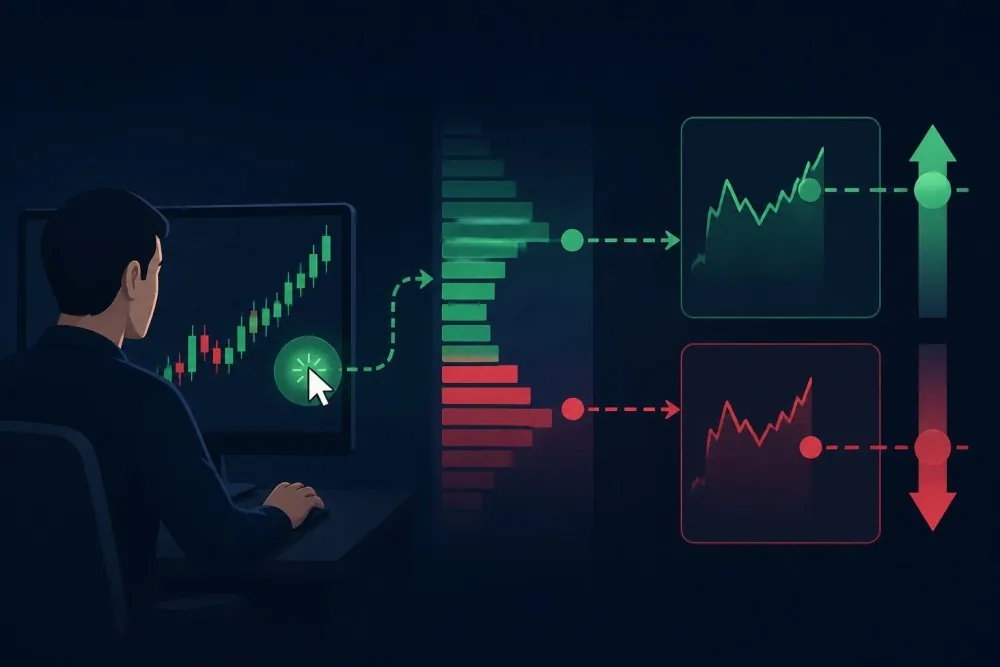
Slippage is defined as the difference between the price you expected when you placed a trade, and the price it actually filled at.
This price difference may work for you or against you.
This is not a fee, but an effect on how the market works.
When trading stocks or other securities, you may encounter the term "slippage". Slippage here means the difference between the price you expected when you placed a trade, and the price it actually filled at. This may happen if you put an order to buy or sell an asset immediately in the market, where the price you landed on can "slip" from the last price you see while clicking the order button.
Slippage Meaning: Expected Price vs Execution Price
Slippage is defined as the difference between the price you expected when you placed a trade, and the price it actually filled at. This price difference may work for you or against you. This is not a fee, but an effect on how the market works.
Let's say, you want to buy a stock. The moment you decide to put a market order to buy, you see that the price is $50.00. However, since it is a market order, the price has moved before your order gets filled, and the execution price you end up paying is $50.02. That $0.02 difference is called slippage.
Why it happens: prices move before your order fills, or there are not enough shares at your price.
The trade-off: some order types (like limit order) protect your price, but may not fill. A market order will almost always fill, but at a price you do not know in advance.
Keep in mind that when you put a market order, there may be slippage between the expected price, which you see on your screen when you send the order, and the execution price. The execution price is the average price your order really filled at.
The U.S. Securities and Exchange Commission (SEC) says the price of a market order is not guaranteed. The last traded price you saw is also not always the price you get. Nasdaq's glossary treats this gap as part of the cost of trading.
There are two kinds of slippages, since you can get a better price than expected, or worse. When an order fill gets a better price than the quote, it is called price improvement. People also call them negative and positive slippage.
Positive Slippage
Negative Slippage
Buy
You pay less than the quote
You pay more than the quote
Sell
You receive more than the quote
You receive less than the quote
Be aware that you cannot predict which one you will get on any single trade, so slippage is just an effect and not a strategy.
How to Calculate Slippage
Use one rule, so a positive number is always a cost to you.
Per-share slippage, buy: fill price − expected price
Per-share slippage, sell: expected price − fill price
Total slippage: per-share slippage × number of shares
Hypothetical example. You place a market order to buy 20 shares. The ask is $50.00, but only 12 shares are offered at that price. The other 8 fill at the next price, $50.05.
12 shares at $50.00 = $600.00
8 shares at $50.05 = $400.40
Average fill = $1,000.40 ÷ 20 = $50.02
Slippage = $50.02 − $50.00 = $0.02 per share, $0.40 in total, or 0.04%
Slippage on a Dollar-Based (Fractional) Order
When you buy by dollar amount, slippage shows up as slightly fewer shares, not a bigger bill.
Hypothetical example. You buy $100 of a stock quoted at $250.00. You expected 0.4000 shares. The order fills at $250.40, so you get about 0.3994 shares. That shortfall is worth about $0.16, or 0.16%.
Slippage Calculator
You can simulate the effect of slippage using this calculator:
Slippage calculator
Why Slippage Happens
There are two main reasons for slippage: the price moves, or the shares run out. For example, when you place a market order for 1,000 shares when the offer is $3.00. Part of it can fill at $3.00. The rest can fill higher if other orders execute first, or if there are not enough shares at $3.00.
Price Moves Before Your Order Fills
As we discussed previously, this happens when there is a short delay between tapping "buy" and the trade. In that time, other orders may be processed ahead of yours. Fast moving markets (especially for day trading) may make this worse, since the expected price you saw can already be out of date.
Not Enough Shares at Your Price
Sometimes, depending on the liquidity of the assets (and how many people are trading those assets), there will be not enough unit of stocks at your expected price. If your order is bigger than the shares offered at the best price, then your order fulfillment will "walk the book". This means it uses up the best price, then the next one, and so on, so it fills at several prices. Heavily traded blue-chip stocks usually have more shares offered near the best price, so this tends to happen less often.
When Does Slippage Become Large?
There are situations when slippage may grow larger. Remember that these are just general consensus, and not a prediction. Every investment carries its own risks.
Situation
Why slippage can grow
What to watch for
Market open and close
Many orders arrive at once
Prices moving fast
Earnings and major news
Prices jump
Stock that opens far from where it closed
Extended hours (outside 9:30 a.m. to 4:00 p.m. ET)
When trading, you can anticipate slippage effects by using limit order. Each order type protects you from a different risk, depending on the situation. Remember that there is no one type that is best for everything.
Order type
What you control
Slippage risk
Trade-off
Market
Getting a fill
Highest
Price can slip
Limit
The worst price you accept
None past your limit
May fill only in part, or not at all
Stop (stop-loss)
Trigger price
Becomes a market order when triggered
Fill price can be far from the stop
Stop-limit
The trigger and a price limit
Capped by the limit
May not execute at all
Trailing stop
A trigger that follows the price
Acts like a stop once triggered
Same as a stop
Example
What is the difference between stop order and stop-limit order? Now let's say, that you hold 10 shares, and you set a sell stop at $80. Then the stock closes at $81, and reopens next morning at $74 after bad news. What happens when you put sell orders:
Stop order: it triggers and becomes a market order. Say it sells at $73.90. That is $6.10 per share below the stop, $61 in total, about 7.6%.
Stop-limit order (stop $80, limit $79): it triggers, but $74 is below the $79 limit. It does not fill. As the result, you still hold the shares at $74.
Fractional-Share Orders
Some brokers allow you to trade fractions of share, and the buy or sell orders may work differently. According to the SEC's fractional share bulletin, there are three things on fractional share trading that can differ by broker firms:
Some firms allow only market orders for fractional shares. That means no price limit.
Some firms group fractional orders and run them later in the day. So the price you get can differ from the price you saw.
Some firms limit after-hours fractional trading.
Check with your own broker to know exactly how fractional share works on their platform.
Slippage vs Spread vs Commission vs Price Gap
Slippage is not a fee, nor a commission. People may mistake slippage as fee, spread, or price gap, when all of those are totally different. See the details here:
Definition
When you know it
How to control
Spread
The gap between the best bid and the best ask
Before you trade
Choose liquid stocks
Slippage
Expected price vs the price you got
After the fill
Order type
Commission or fee
A charge from your broker
Stated
You can choose a broker
Price gap
A jump in price between sessions
When the next session opens
None
How Much Slippage Is Normal for Stock Trades?
There is no single number that defines a "normal slippage", and it all depends on the stock's liquidity, your order size, the time of day, and the order type. In a 2025 Journal of Finance study, Schwarz, Barber, Huang, Jorion and Odean placed 85,000 market orders at the same time through six accounts at five U.S. brokers. They found average round-trip execution costs of 0.07% to 0.46%, not counting commissions. The gap came from how off-exchange wholesalers priced the same trades for different brokers. (paper record, plain summary)
However, this is just one study's past sample, and it is not a forecast or a broker ranking. A good way to learn is to take note, and compare the fill prices on your own trade confirmations with the quotes you saw.
Practical Ways to Reduce Slippage
Although we cannot really remove the risk of slippage, there are things we can try to manage the risks. As usual, there is no guarantee on profit, and every trade carries its risks.
Use a limit order when price matters more than speed
Be careful with market orders right after the open or big news
Act during regular trading hours when you can
Check the spread and volume before trading thinly traded stocks
Keep your order small compared with the shares offered
Learn how stop and stop-limit orders act
Frequently Asked Questions About Slippage
Is slippage a fee?
No. A fee is a charge your broker states up front, while slippage is the gap between the price you expected and the price you got. It comes from the market moving or running out of shares.
Can a limit order have slippage?
A limit order will not fill at a worse price than your limit. The trade-off is that it may fill only in part, or not at all, if the market does not reach your price.
Why did my stop-loss sell below my stop price?
A stop price is a trigger, not a promised price. Once it is hit, the order becomes a market order. If the price falls fast or gaps down, it can fill well below your stop.
Is slippage good or bad?
It can be either. Negative slippage costs you. Positive slippage, called price improvement, helps you, but you have no control over these.
What is slippage tolerance in crypto?
It is a setting on crypto swaps. It sets how much worse than the quote you will accept. If the price moves past that limit, the swap is cancelled. The idea is the same as in stocks.
Can slippage be avoided completely?
No. You can reduce it with limit orders, liquid stocks and sensible timing. But prices can move at any time, so some slippage risk always remains.
Gotrade is the trading name of Gotrade Securities Inc., which is registered with and supervised by the Labuan Financial Services Authority (LFSA). This content is for educational purposes only and does not constitute financial advice. Always do your own research (DYOR) before investing.
Sindhu Partomo is a copywriter and content writer with 8+ years of experience in agencies, B2B, and SaaS. He has been writing about business and finance since 2023, and holds a bachelor degree from University of Indonesia.
Hendrie Saputra holds a Master of Business Administration (MBA) with a concentration in Business Risk & Finance, along with professional experience in finance, marketing, and project management. He is experienced in analyzing market data and developing research-driven business strategies.