
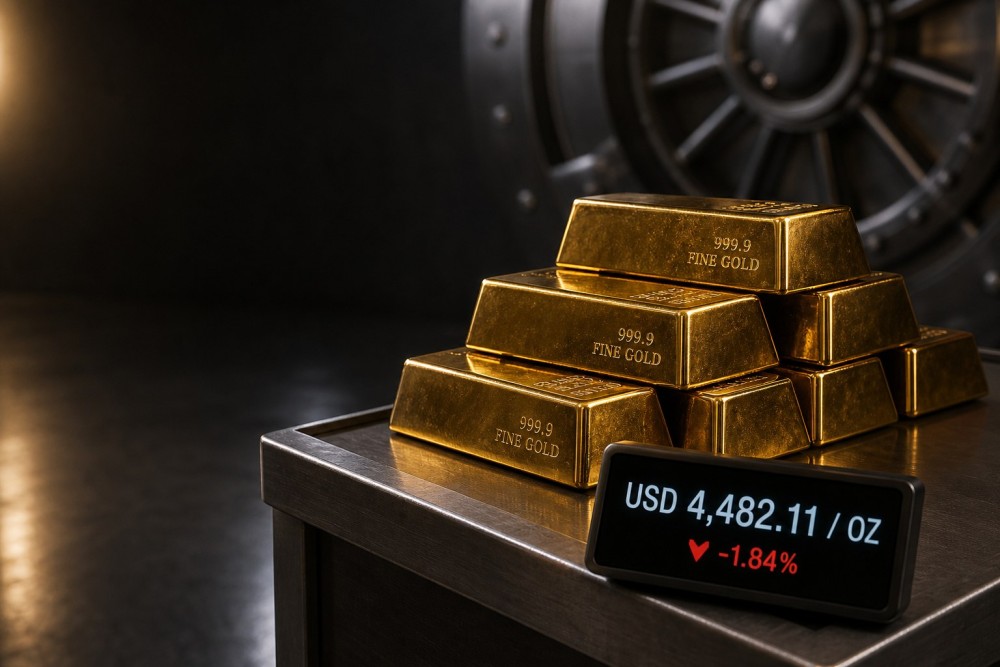
Gotrade News - Spot gold dropped 1.84 percent to $4,482.11 an ounce on Tuesday, hitting its lowest level since late March. Comex June gold futures also slipped 1.8 percent to $4,476.80 an ounce in the same session.
The selloff was driven by a firmer US dollar and a sharp jump in the 10-year Treasury yield. The combination eroded gold's appeal as a non-yielding safe-haven asset.
Key Takeaways
- Spot gold fell 1.84 percent to $4,482.11 an ounce, the lowest since late March.
- The 10-year Treasury yield touched a one-year high, weighing on precious metals.
- Silver tumbled 5.7 percent and platinum lost 2.8 percent as the selloff spread.
Dollar and Yields Pressure Bullion
According to IDX Channel, the 10-year Treasury yield ended the session near its highest level in over a year. Higher real rates pushed investors toward yield-bearing assets and away from bullion.
Edward Meir of Marex said rising global real interest rates and a stronger US dollar were the main forces dragging gold lower. A firmer greenback also makes dollar-priced gold more expensive for overseas buyers.
As reported by Liputan6, some readings showed spot gold briefly down 2 percent to $4,474.40 an ounce. Comex June futures in the same window were quoted 1.8 percent lower at $4,476.80 an ounce.
Selling pressure spread quickly across the broader precious metals complex. Silver slid 5.7 percent to $73.25, platinum lost 2.8 percent to $1,923.55, and palladium fell 3.3 percent to $1,371.25.
The drop also hit shares of major bullion producers. Investors are watching producers such as Newmont (NEM) as a real-time gauge of margin sensitivity to gold prices.
Outlook and Investor Positioning
Per Bloomberg Technoz, spot gold traded at $4,486.10 an ounce at 07:05 WIB on Tuesday. That marked a 0.12 percent decline from the prior close near $4,491.40 an ounce.
Geopolitical risk is adding another layer of volatility to commodity markets. Reported threats from Washington toward Iran have unsettled sentiment across the global commodities complex.
Ole Hansen, Head of Commodities Strategy at Saxo Bank, said the structural investment case for gold remains intact despite the recent correction. He expects central-bank buying to reassert itself once energy-related selling pressure fades.
Markets are now turning to the next Federal Reserve meeting minutes for clearer signals on the rate path. Any dovish tilt could quickly reverse the recent strength in the dollar and Treasury yields.
Investors seeking diversified exposure can consider broad bullion vehicles such as SPDR Gold Shares (GLD). The fund tracks physical gold and offers a direct way to participate in any rebound in bullion prices.
For exposure to mining equity beta, the VanEck Gold Miners ETF (GDX) bundles the leading global gold producers. Miner shares typically amplify both upside and downside moves in the underlying gold price.
The dollar's trajectory will likely remain the dominant short-term driver for bullion. As long as Treasury yields stay elevated, the room for sustained gold rallies looks limited without a fresh catalyst.
Position sizing becomes more important when volatility across precious metals rises this sharply. Staggered entries tied to a medium-term horizon typically suit retail investors better than aggressive single-shot allocations.