
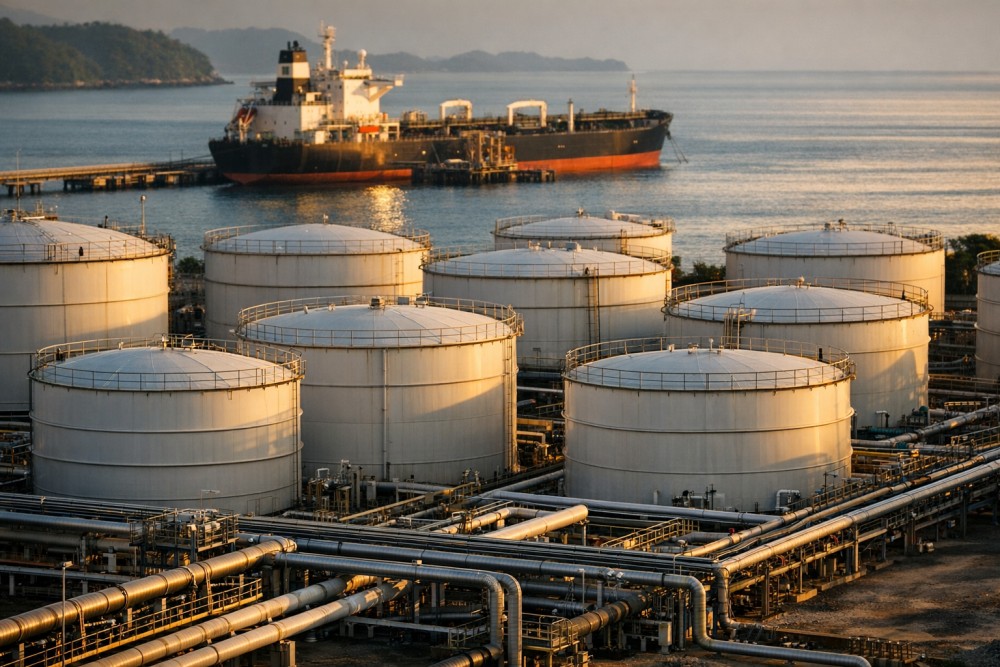
Gotrade News - Indonesia pitched itself as ASEAN's oil reserve storage hub at the regional summit in the Philippines on Sunday. Energy Minister Bahlil Lahadalia made the offer as Strait of Hormuz risks reshape global crude logistics.
The proposal lands as Tokyo stockpiles UAE barrels and Jakarta finalizes Russian supply, signaling broader supply chain diversification. US investors are watching crude benchmarks, integrated majors, and energy ETFs for spillover into Asian storage demand.
Key Takeaways:
- Indonesia invited ASEAN members to co-build an oil storage hub on Indonesian territory at the Manila summit.
- The pitch follows a closed Russia oil supply deal and Japan's preemptive UAE stockpiling against Hormuz disruption.
- US energy majors and crude ETFs may benefit from sustained Asian buffer-stock demand and tighter seaborne flows.
Bahlil unveiled the proposal on the sidelines of the ASEAN Summit, framing storage capacity as a regional energy security backbone. According to Kabar Bursa, the minister pitched Indonesia's geography as ideal for shared reserves.
The offer aligns with Indonesia's separate procurement push to lock in Russian crude under a freshly closed contract. Per Kumparan, the cargoes are slated to ship to Indonesia soon.
Why Hormuz Risk Is Reshaping Asian Storage
Japan moved first, adding UAE barrels to national stocks as a hedge against an extended Strait of Hormuz blockade. As reported by Kompas, Tokyo is anticipating prolonged chokepoint disruption.
Bloomberg Technoz outlined market scenarios in which a blockade extending into June could tighten seaborne supply and lift premiums. According to Bloomberg Technoz, Brent could see structural backwardation deepen.
Indonesia's hub pitch positions the archipelago as an alternative buffer location east of the Hormuz chokepoint, closer to demand centers. The strategic logic mirrors how Singapore built its bunkering and storage dominance over four decades.
What It Means for US Energy Investors
Sustained Asian buffer-stock demand can keep a floor under physical crude and support refining throughput across the Pacific basin. The United States Oil Fund (USO) tracks WTI front-month and would reflect any premium expansion from chokepoint risk.
Integrated majors with global trading desks and shipping exposure are positioned to monetize regional arbitrage opportunities. Exxon Mobil (XOM) operates one of the largest crude trading books and could benefit from widened spreads.
According to Bloomberg Technoz, Bahlil framed the hub as an open invitation to ASEAN members rather than a unilateral facility. The structure would let neighbors co-fund storage without sovereign-only commitments.
For diversified majors with downstream Asian exposure, the proposal hints at long-dated infrastructure offtake potential. Chevron (CVX) retains regional refining and trading relationships that could intersect with a multilateral hub.
The Russia supply linkage adds a geopolitical wrinkle, since Western sanctions regimes treat sanctioned-origin barrels with scrutiny. Indonesia's framing positions the deal as commercial rather than aligned with any bloc.
If the hub materializes, it would mark Southeast Asia's most ambitious shared-reserve structure since the IEA-style strategic petroleum framework. Execution timelines, financing, and member commitments remain undisclosed at the summit stage.
Crude traders will watch for follow-up bilateral statements from Malaysia, Thailand, and the Philippines in the coming weeks. Concrete capacity numbers and site selection would be the next tangible signals for energy markets.
Sources:
- Bahlil: Russia Oil Contract Already Deal-Closed for Indonesia (Kumparan)
- Indonesia Offers Itself as ASEAN Oil Reserve Hub (Kabar Bursa)
- Bahlil Invites ASEAN Members to Build Oil Storage Hub in Indonesia (Bloomberg Technoz)
- Oil Market Scenarios If Strait of Hormuz Blockade Extends to June (Bloomberg Technoz)
- Japan Adds Oil Stocks From UAE, Anticipating Strait of Hormuz Blockade (Kompas)