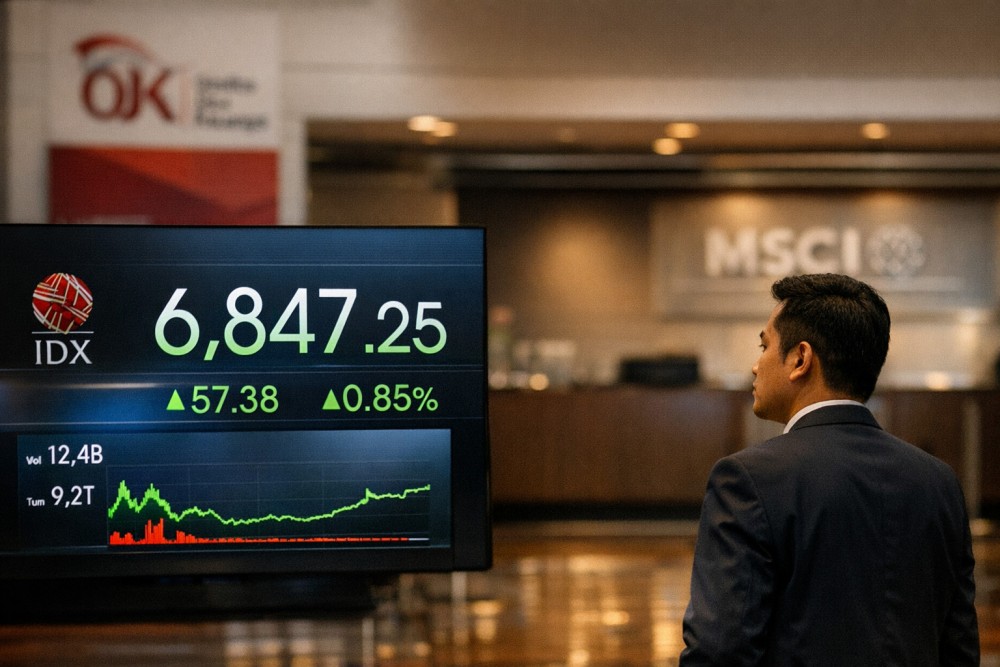

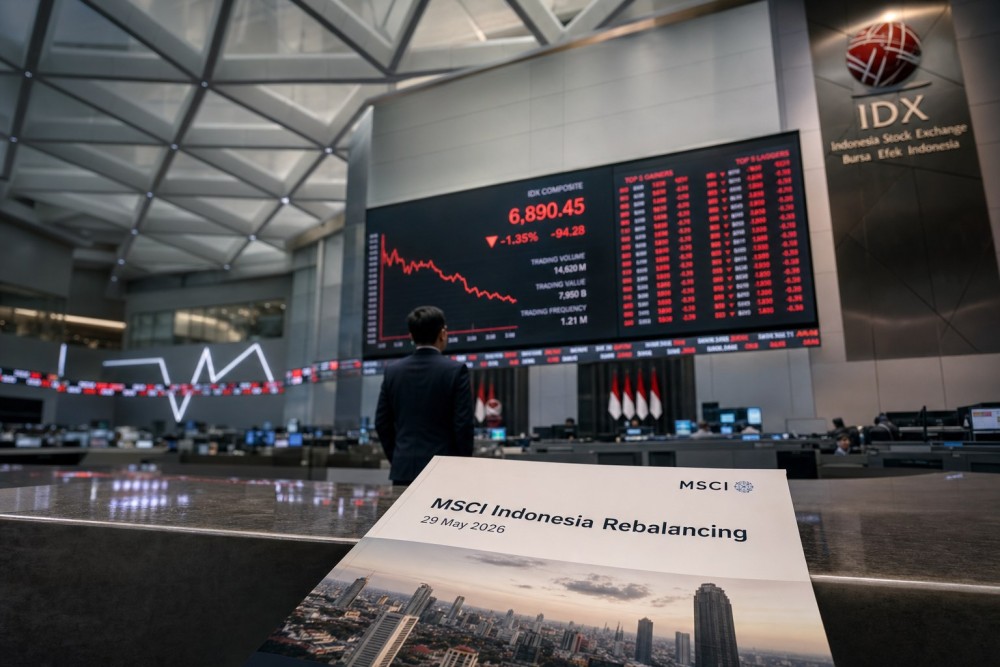
Gotrade News - MSCI will unveil its May 2026 index rebalancing on May 13, with analysts forecasting up to $1.8 billion in passive fund outflows. Implementation falls on May 29, putting Indonesian conglomerate stocks like Barito Renewables and Dian Swastatika Sentosa squarely in the spotlight.
The reshuffle of the MSCI Indonesia Standard Cap Index, a benchmark tracked by global passive funds for emerging-market exposure, has weighed on local sentiment ahead of the announcement. The Jakarta Composite Index slid 1.22 percent in Tuesday's session as traders repositioned ahead of the changes.
Key Takeaways
- CGS International estimates roughly $1.8 billion of passive outflows tied to the May 29 rebalancing implementation date.
- Barito Renewables (BREN) and Dian Swastatika Sentosa (DSSA) face removal risk over high shareholding concentration.
- Global investors can track the event through US-listed proxies including the iShares MSCI Indonesia ETF.
Conglomerate Stocks Under Pressure
According to Kompas Money, Mirae Asset Sekuritas senior analyst Nafan Aji Gusta flagged BREN and DSSA as the most exposed names. Both stocks risk removal because of high shareholding concentration that limits effective free float for foreign investors.
Amman Mineral Internasional (AMMN), Petrindo Jaya Kreasi (CUAN), and Charoen Pokphand Indonesia (CPIN) could see their Foreign Inclusion Factor reduced by KSEI, Indonesia's central securities depository. A lower factor means passive funds must trim their holdings to match the new index weights.
As reported by Liputan6, Sumber Alfaria Trijaya (AMRT) and GoTo Gojek Tokopedia (GOTO) may be downgraded from the Global Standard Index to the Small Cap Index. Such downgrades typically trigger forced selling by funds tracking the standard benchmark.
Global investors seeking direct exposure to this market often use the iShares MSCI Indonesia ETF (EIDO), which mirrors the same index facing reshuffling. The fund offers a transparent lens on how passive flows could move during the May 29 session.
Sizing the Outflow and Market Reaction
Per Bloomberg Technoz, CGS International analyst Hadi Soegiarto pegged total passive outflows at about Rp31.5 trillion, or roughly $1.8 billion. The bulk of those flows typically concentrate near the close on implementation day.
Volatility on the actual rebalancing day tends to stay contained because passive managers telegraph their trades in advance. Active investors often provide liquidity at the close, absorbing one-way pressure from index-tracking funds.
The index provider itself, MSCI, Inc. (MSCI), runs quarterly and semi-annual reviews that ripple through emerging-market portfolios worldwide. Each review can shift billions in passive allocations across single-country and regional funds.
Broader emerging-market vehicles like the Vanguard FTSE Emerging Markets ETF (VWO) are less sensitive to single-country reshuffles, since Indonesia represents a smaller slice of their geographic weighting. Investors comparing exposure paths often weigh single-country precision against regional diversification.
Indonesia's Financial Services Authority, the country's equivalent of the SEC, framed the episode as a healthy test. OJK Chair Friderica Widyasari Dewi said short-term discomfort strengthens long-term market integrity, noting the country now has 26 million investors.
Technically, the Jakarta Composite Index shows a bullish divergence on its Relative Strength Index even as prices grind lower. That setup can hint at a potential rebound once the rebalancing-related selling pressure clears.