

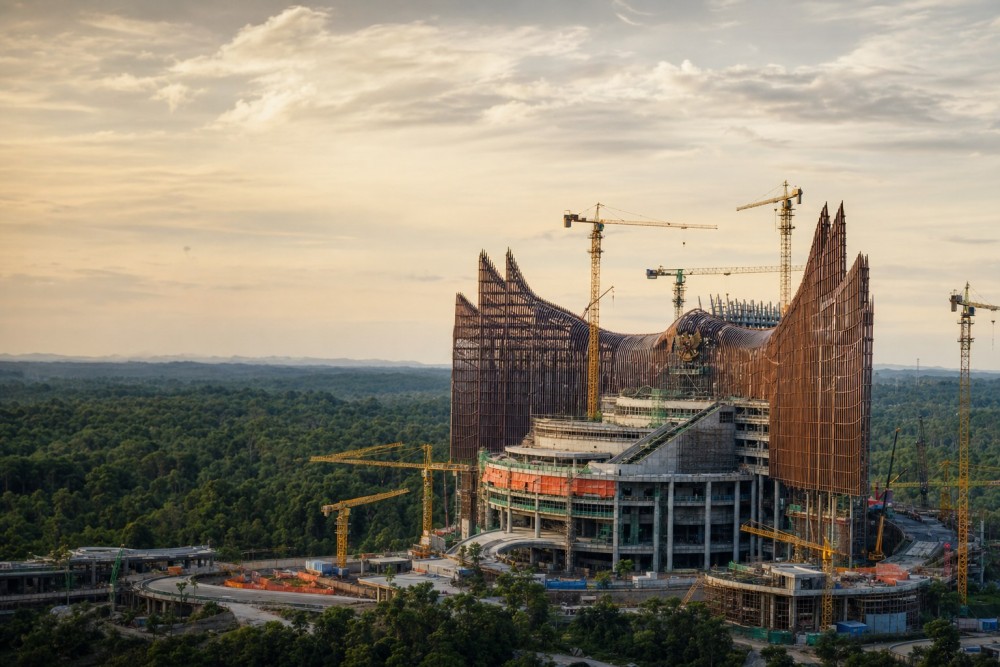
Gotrade News - Indonesia's Constitutional Court ruled that Jakarta remains the country's official capital, rejecting a challenge to the existing capital law. The new capital authority confirmed that construction of Nusantara, the planned replacement capital, will continue on schedule toward a 2027 milestone.
The ruling removes a layer of legal uncertainty around Indonesia's long-running capital relocation plan and signals policy continuity to global investors. Stable policy signals are relevant for funds tracking Indonesian equities and for commodity exposures tied to the country's infrastructure pipeline.
Key Takeaways
- Indonesia's Constitutional Court rejected the petition challenging the IKN law, affirming Jakarta as capital until a presidential decree formalizes any move.
- The IKN authority said core infrastructure, government zones, and public service buildout in East Kalimantan continue on the original timeline.
- The legislative and judicial complex in Nusantara is targeted for completion in 2027, with a final deadline in the first half of 2028.
Court Ruling and IKN Authority Response
According to Kompas, the Constitutional Court bench led by Chief Justice Suhartoyo rejected the petition in its entirety on Tuesday, May 12, 2026. The case examined Article 2(1) of the 2024 Jakarta law alongside Article 39(1) of the 2022 law establishing Ibu Kota Nusantara, the planned new capital in East Kalimantan.
Petitioners argued the two statutes were inconsistent and created ambiguity over Indonesia's official capital. The court ruled that Jakarta retains its status as the capital city until a presidential decree, known locally as a Keppres, formally enacts the relocation.
As reported by Bloomberg Technoz, IKN Authority spokesperson Troy Pantouw said the agency respects the full constitutional process at the court. He framed the legal review as a normal part of Indonesian democratic governance that must run its course.
Pantouw confirmed that the Nusantara buildout will proceed according to the government's existing phasing plan. Basic infrastructure, government zones, business ecosystem development, and public services will continue on the original schedule.
Implications for International Investors
Legal clarity on the capital question reduces a recurring policy overhang that global investors have flagged on Indonesian assets. The signal is relevant for funds that track the domestic equity market, such as the iShares MSCI Indonesia ETF (EIDO).
Per the IKN Authority, the legislative and judicial complex remains targeted for completion in 2027, with a final deadline set for the first half of 2028. A firmer timeline helps investors assess medium-term infrastructure spending in East Kalimantan.
The Nusantara build also has implications for demand for copper and base metals sourced from Indonesian mines. International exposure to a major copper producer active in Indonesia is available through Freeport-McMoRan (FCX), which operates the Grasberg mine in Papua.
For investors with broader emerging-market mandates, Indonesia's policy stability narrative feeds into the regional risk mosaic. Diversified access is available through instruments such as the Vanguard FTSE Emerging Markets ETF (VWO), which includes Indonesian equities alongside other developing markets.
The court ruling is a clarification of existing statutes rather than a change in the direction of the capital move. The government still controls the timing of any formal relocation through a future Keppres.
Market participants will continue to watch IKN budget execution, private investor tender progress, and the timing of any relocation decree. These factors will determine whether construction momentum holds in line with the authority's stated commitments.