
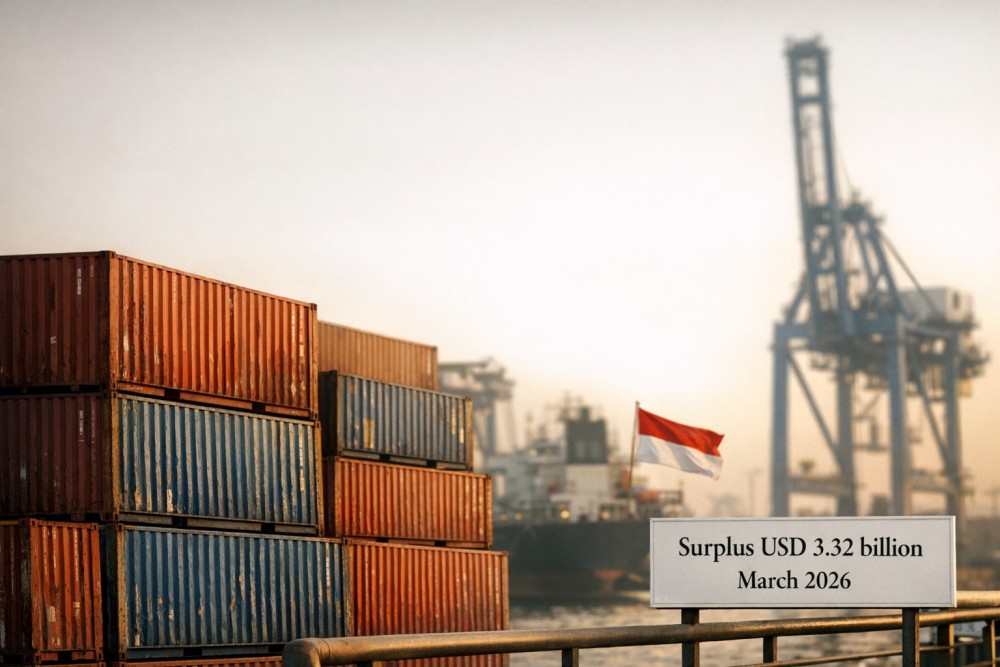
Gotrade News - Indonesia's Statistics Agency (BPS) reported a March 2026 trade surplus of USD 3.32 billion, extending a 71-month streak of monthly surpluses since May 2020. The headline looks healthy, yet the import side is moving faster than exports.
For the first quarter of 2026, the cumulative surplus stood at USD 5.55 billion based on BPS data. The mix beneath that number reveals how much Southeast Asia's largest economy still leans on Chinese supply chains.
Key Takeaways
- Indonesia's Q1 2026 imports rose 10.05% YoY to USD 61.30 billion, while exports edged up only 0.34%.
- China supplied 41.56% of non-oil imports, pushing Indonesia's bilateral deficit with Beijing to USD 5.52 billion.
- Plastic imports reached USD 2.55 billion in Q1, with 34.79% sourced from China amid global price pressure.
Q1 2026 exports totaled USD 66.85 billion, growing just 0.34% year-over-year. BPS noted the processing industry was the bright spot with a 3.96% expansion.
Imports told a different story, climbing 10.05% YoY to USD 61.30 billion over the same period. Non-oil imports alone surged 12.16% to USD 52.97 billion, according to BPS Deputy Ateng Hartono.
Capital goods led the rise with a sharp 24.02% jump to USD 12.98 billion. The pickup signals stronger domestic investment activity at the start of the year.
The oil and gas segment continued to drag, posting a USD 5.08 billion deficit in Q1. That offset the USD 10.63 billion non-oil surplus and tempered the overall trade gain.
China Cements Its Position as Top Supplier
China remained Indonesia's largest import partner with USD 22.02 billion in Q1 2026 shipments. That share equals 41.56% of all non-oil imports flowing into the archipelago.
Together with Australia and Japan, the trio accounted for 52.97% of Indonesia's non-oil imports. The concentration highlights how dependent local manufacturing has become on Asia-Pacific suppliers.
The top categories from China were mechanical machinery (23.18%), electrical machinery (22.20%), and vehicles plus parts (5.49%). These are the inputs Indonesian factories need to keep producing finished goods for domestic and export markets.
As a result, Indonesia's bilateral trade deficit with China widened to USD 5.52 billion in Q1 2026. That is up from a USD 5.23 billion gap recorded in the January-February window.
Plastic Imports Highlight Raw Material Reliance
Plastic and plastic products stood out as a watch-item commodity. The category drew USD 2.55 billion (about IDR 44.11 trillion) of imports during Q1 2026.
Volume reached 1.65 million tons, growing 7.42% YoY according to BPS figures. March alone saw a 14.96% monthly drop to USD 338.1 million in plastic import value.
China supplied 34.79% of Indonesia's plastic needs, ahead of Singapore at 12.35% and Thailand at 11.65%. Geopolitical tension in the Middle East has lifted global plastic prices, adding cost pressure for downstream buyers.
For investors tracking Asian trade flows, the data points to ongoing input-cost sensitivity for Indonesian manufacturers, packagers, and automakers. Currency moves and commodity prices will continue to shape margin outcomes for these sectors.