

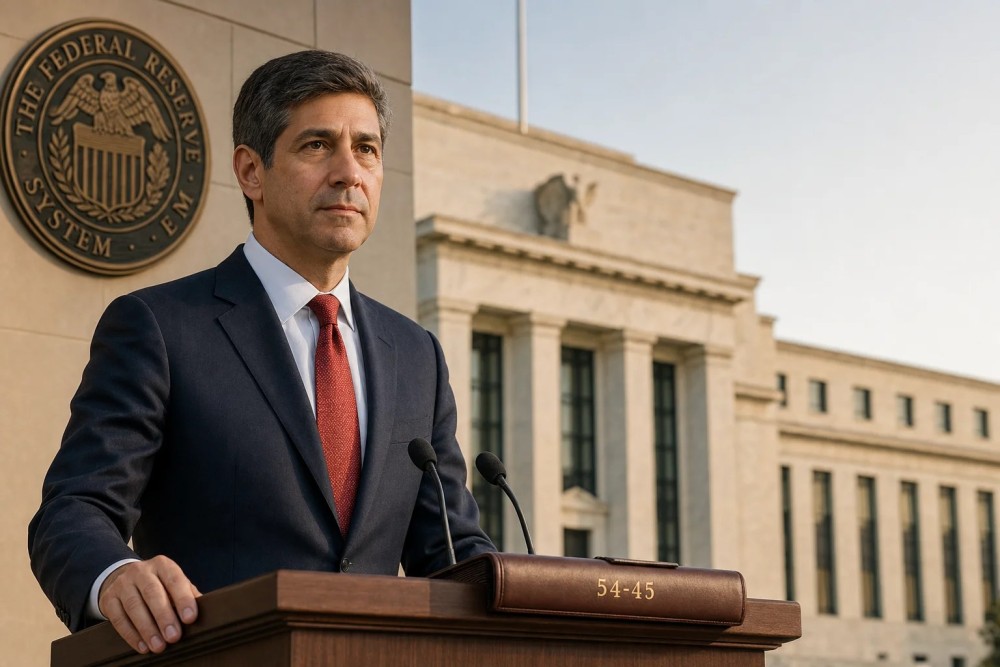
Gotrade News - The U.S. Senate confirmed Kevin Warsh as the next Federal Reserve chair on Wednesday in a 54-45 vote. Warsh succeeds Jerome Powell, whose term as chair ends on Friday, May 16, 2026.
The confirmation arrives with inflation still above the Fed's 2% target, raising stakes for monetary policy. Markets are now repricing rate-cut odds as Warsh prepares to take the helm of the central bank.
Key Takeaways
- Kevin Warsh becomes the 11th Federal Reserve chair of the modern banking era.
- The 54-45 vote split along party lines, with only Sen. John Fetterman crossing over.
- President Trump publicly expects Warsh to cut interest rates after criticizing Powell's tight stance.
A Contentious Path to Confirmation
According to CNBC, the Senate voted 54-45 to install Warsh atop the Federal Reserve. Pennsylvania Democrat Sen. John Fetterman was the lone member of his party to back the nominee.
The process briefly stalled when Sen. Thom Tillis (R-NC) raised concerns tied to a DOJ probe into Powell. Per NPR, Tillis ultimately allowed the nomination to advance to a final floor vote.
Warsh previously served as a Fed governor during the 2008 financial crisis, giving him hands-on experience with market dislocations. His confirmation closes a months-long succession question that had hung over rate-sensitive assets like the 20 Yr Treasury ETF (TLT).
Powell exits with inflation still running hotter than the central bank's target, complicating the handoff. As reported by CNN Business, Trump has openly pressured the Fed to ease policy and expects Warsh to deliver cuts.
Market Read-Through for Investors
Equity benchmarks tracked by the S&P 500 ETF (SPY) tend to respond sharply to shifts in Fed leadership. Traders are weighing whether Warsh's tenure will deliver the dovish pivot the White House has publicly demanded.
Bank stocks within the SPDR Financial Sector ETF (XLF) stand to benefit if a steeper yield curve emerges under new leadership. Lower short-end rates against sticky long-end yields would widen net interest margins across the sector.
Long-duration Treasuries face a more nuanced setup as inflation expectations enter the calculus. According to CNBC, Warsh has historically warned against premature easing during inflationary periods.
That hawkish track record sits awkwardly with Trump's stated rate-cut expectations heading into the transition. Investors should watch Warsh's first public remarks for clues on how he plans to balance political pressure with the Fed's dual mandate.
The 11th chair inherits a balance sheet still well above pre-pandemic levels and a labor market showing early cracks. His policy framing in the opening months will set the tone for risk assets through the second half of 2026.