
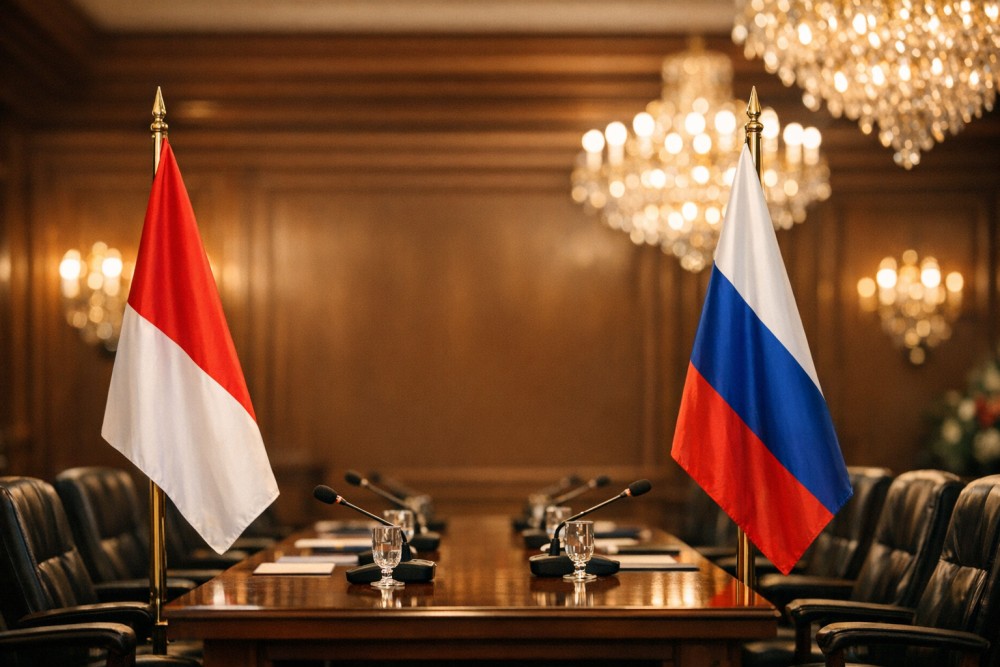
Gotrade News - President Prabowo Subianto and Russian President Vladimir Putin have agreed to strengthen bilateral ties in energy and investment, signaling a strategic pivot for Indonesia's resource policy. The agreement comes at a moment when global oil prices have surpassed $100 per barrel and supply chains through the Strait of Hormuz remain disrupted.
Indonesia's Coordinating Minister for Economic Affairs Airlangga Hartarto confirmed that investors responded positively to the presidential diplomatic circuit, which included visits to the UK, South Korea, and Japan. According to Kompas Money, Indonesia recorded Rp 497 trillion in investment realization during Q1 2026, a 7% year-on-year increase.
Key Takeaways:
- Prabowo and Putin agreed to expand cooperation across energy and investment sectors between Indonesia and Russia.
- Indonesia's Q1 2026 investment realization reached Rp 497 trillion, up 7% year-on-year, though slower than the 15.6% growth recorded in Q1 2025.
- The government has prepared economic scenarios including a worst-case oil price assumption of $92 per barrel for 2026.
Strategic Rationale Behind the Deal
Indonesia's Investment Minister Rosan Roeslani highlighted the country's geopolitical neutrality as a key competitive advantage in attracting investors from all sides of the current global divide. This neutrality has become increasingly valuable as US-China tensions and the Iran conflict have forced many multinational investors to reassess their portfolio geography.
The 7% investment growth in Q1 2026 represents a clear slowdown from the 15.6% pace recorded in Q1 2025. Rosan attributed this deceleration to broader global uncertainty rather than a loss of confidence in Indonesia's investment climate.
Deepening energy cooperation with Russia gives Indonesia access to a more diversified energy supply base. This matters particularly now, as Indonesia's fuel import costs are directly exposed to the current Middle East supply shock.
Economic Resilience Amid External Pressure
Finance Minister Purbaya Yudhi Sadewa stated that Indonesia's macroeconomic fundamentals remain intact, with debt-to-GDP and deficit-to-GDP ratios both within safe thresholds. According to Kompas Money, Purbaya described Indonesia as the fastest-growing economy among G20 members.
Indonesia's economy grew 5.11% year-on-year in 2025, with government projections pointing to 5.5% to 6% growth for Q1 2026. These projections were built using conservative scenarios, including a worst-case oil price of $92 per barrel.
The government confirmed there are no planned changes to the 2026 state budget assumptions despite rising commodity price volatility. This fiscal discipline reinforces Indonesia's position as a stable investment destination even as geopolitical risks escalate globally.
Energy stocks including Exxon Mobil and Chevron remain closely watched by investors tracking the downstream impact of Middle Eastern supply disruptions. Enbridge offers exposure to energy infrastructure, a segment that could benefit as countries like Indonesia seek more diversified supply routes.
The Indonesia-Russia energy partnership, if operationalized, could reduce Jakarta's dependence on Hormuz-linked supply chains in the medium term. The success of that diversification effort will depend on how quickly infrastructure agreements can be converted into actual energy flows.
Sources: