

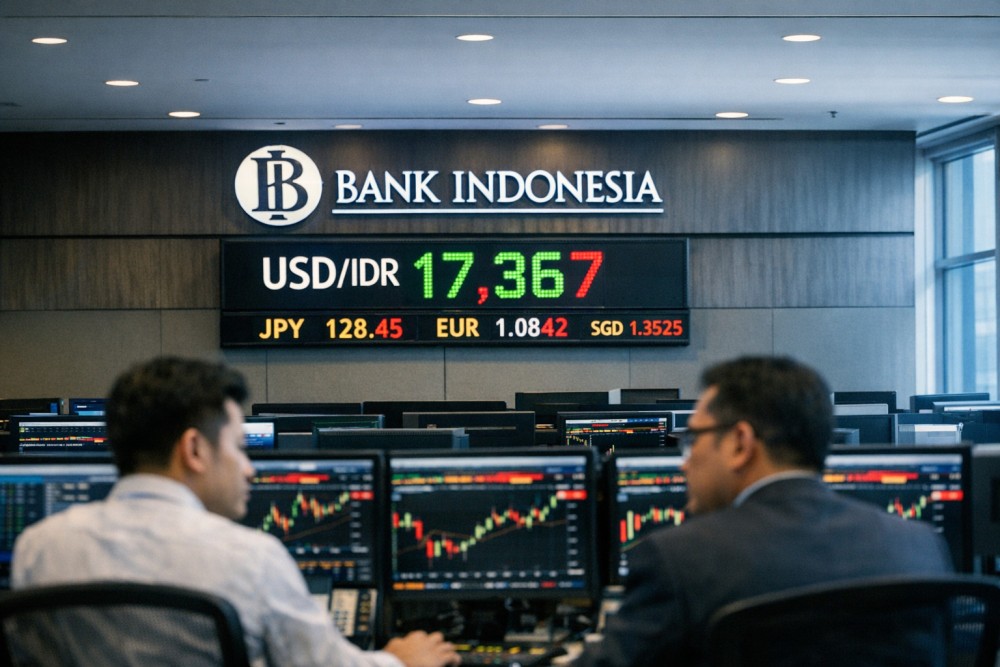
Gotrade News - The Indonesian rupiah traded in a tight 17,337 to 17,367 range against the US dollar on Monday, May 4, 2026. The currency opened modestly stronger at 17,335 with a 0.1% gain, before drifting toward the 17,367 level by midday as regional dollar demand picked up, according to Bloomberg Technoz.
The move came hours before Indonesia's statistics agency released April inflation data and ahead of the country's monthly trade balance figures due later this week. Currency markets remained in wait-and-see mode pending fresh signals on domestic momentum and US monetary policy direction.
Key Takeaways
- The rupiah traded between 17,337 and 17,367 per US dollar on May 4, with year-to-date depreciation at 3.54%.
- Bank Indonesia continued interventions across NDF, spot, DNDF, and secondary government bond markets to dampen volatility.
- Pressure stems primarily from Middle East geopolitical tensions and rising oil prices, not domestic fundamentals.
Government Frames Pressure as Global, Not Domestic
Coordinating Minister for Economic Affairs Airlangga Hartarto emphasized that rupiah weakness is not unique to Indonesia. The government is monitoring peer countries facing similar currency pressure amid broader international financial market dynamics, kumparan reported.
Bank Indonesia Deputy Governor Destry Damayanti added that the rupiah's movement aligns with broader regional currency depreciation. Indonesia's foreign reserves stood at USD 148.2 billion at end-March 2026, a level the central bank views as sufficient to support continued FX market operations.
Geopolitics Drives Volatility for Emerging Market Currencies
Currency and commodity analyst Ibrahim Assuaibi estimates roughly 50% of the pressure on the rupiah comes from geopolitical factors. Iran-US-Israel tensions and the Israel-Lebanon situation have driven global investors toward safe-haven assets, strengthening the dollar against emerging market currencies, Katadata reported.
Rising oil prices have become the primary transmission channel for these pressures into Indonesia. Ibrahim warned that if crude prices break above USD 150 per barrel, global central banks including the Federal Reserve may resume rate hikes, which would further weigh on emerging market currencies.
For investors managing dollar exposure, energy stocks tied to oil price momentum remain a relevant theme. Producers such as Exxon Mobil (XOM) and Chevron (CVX) typically serve as proxies for global energy price strength during geopolitical risk episodes.
What to Watch This Week
April inflation data released today by Indonesia's statistics agency is the first key catalyst. Kompas reports the April reading is expected to moderate from prior months, although energy-driven price pressure in May still warrants monitoring.
After inflation, attention shifts to the trade balance release and recent manufacturing PMI data, which has already shown contraction. The combined readings will determine whether the rupiah holds in the 17,300s range or extends weakness to new lows.
For investors looking to hedge currency risk, instruments such as the Invesco DB US Dollar Index Bullish Fund (UUP) and gold ETFs like SPDR Gold Shares (GLD) remain common diversification tools during periods of geopolitical uncertainty.
Conclusion
The rupiah will continue to be tested by the combination of domestic data and global geopolitical dynamics this week. Active Bank Indonesia intervention provides a cushion, but the 17,300s range may emerge as a new psychological reference point for as long as external pressures persist.
Want to diversify into US stocks as a hedge against rupiah volatility? Open a Gotrade account and access thousands of US-listed equities from as little as Rp10,000, all from your smartphone.