Back then the stock trade was very limited to only those people working in financial institutions or brokerages. As technology advances, the game has shifted and day trading has become a trend due to online trading platforms offering a seamless update of news information and an easy to use platform for retail investors to start day trading.
Day trading has been a trend for several years and can actually be profitable if done correctly. This is where new retail investor often misled because day trading is typically challenging if you don't understand the market fundamentals and technical strategies.
You will learn what day trading is, how to start and what changes in 2026 through this article.
What Is Day Trading?
Day trading is an approach to rapidly buying and selling securities in a single trading day that makes this approach a high-risk one. This approach can also be applied to other financial instruments such as stocks, currencies, or futures depending on the platforms.
Day trading benefits from small stock price movement or other financial instruments that are highly liquid. This approach is not suitable for every investor because day trading requires strict risk controls, a well prepared trading plan, and continuous monitoring.
How Does Day Trading Work?
A day traders open and close position in hours, minutes, or even seconds to achieve market inefficiencies and price fluctuations, day traders usually close out all their trades before the market closes. This approach is very different from other trading approaches such as long trade and swing trade
1. Trading Session
Day trading starts when the market opens, the US market opens at 9:30 a.m. and closes at 4:00 p.m. There is also a pre-market session typically run from 4:00 a.m. to 9:30 a.m which have a thinner trading volume and a wider spread.
Day traders actively avoid the price overnight gap because the stock price can move during the market closes because of the news during that period, meaning the position has no exit until the market reopens if it is held overnight.
2. What a day trader is reacting to
Day trading approach heavily reacts to intraday price movement, trading volume, news, and the stock liquidity.
Liquidity has more impact here, a liquid stock will have many active traders, so the spread will stay narrow and will stay close to the actual quoted price, if the traded stocks have a wider spread, the cost will be doubled on the way in and on the way out.
What Do You Need to Start Day Trading?
Three things. An account that permits the activity, capital alongside a platform that executes quickly, and a written plan agreed before the first order.
1. The right account type and the margin rules that apply
There has been a change in the US rules in 2026. The SEC approved FINRA's amendments to Rule 4210 on April 14, 2026, and FINRA published Regulatory Notice 26-10 on April 20, 2026. The amendments took effect on June 4, 2026, replacing the day trading margin requirements with intraday margin standards. The $25,000 minimum equity requirement no longer applies and no pattern day trader designation based on counting trades.
A firm now will monitor whether an account holds enough equity during the trading day to cover its open positions, if equity is insufficient, this condition is referred to as an intraday margin deficit and must be met immediately. Repeatedly failing these new regulations can restrict their account for up to 90 days
Firms have until October 20, 2027 to align with the new standards so some still operate the older rules.
The minimum capital requirement for day trading will follow the broker/platform own requirement which is vary.
The more important thing than starting capital is what you can do on that platform, you can check their features and their responsiveness to the market compared to the other platform. Also for the day traders the platform cost will be crucial because they are charged per trade and accumulate based on the trade frequency
3. A written plan before the first trade
You will need a written trading plan that is going to be your threshold in entry, exit, sizing, or cutting loss. This plan should be planned before the market opens and you can't adjust it mid-market, this is going to be a crucial one for a day trader.
What Are the Risks of Day Trading?
Since this approach requires advanced technical skills and fundamental analysis the risks can vary between; most retail day traders lose money, and the losses trace to costs, leverage, and faster competition.
1. Most retail day traders lose money
One Journal of Financial Markets study in 2014 covered the Taiwan Stock Exchange from 1992 to 2006. It found that fewer than 1 percent of day traders earned positive abnormal returns net of fees, predictably and reliably.
Another research in Brazil, a study tracked everyone who day trades Brazilian equity futures between 2013 and 2015. Those who lasted for 300 days, 97% of them lost their money and only 1.1% earned more than the minimum wage
Those two study researched different market, financial instruments, and period, but they still found the same results
2. Leverage and margin amplify losses
Margin increases exposure in both directions. Borrowed money produces a larger gain when price moves your way, and a larger loss when it does not.
If your account equity falls below the level the firm requires, the firm issues a margin call which a position can be closed out to fill it, at whatever price the market offers.
3. Costs, taxes, and time
Day trading requires a high volume of trades, if a day trader executes fifty transactions, they must pay transaction fees fifty times over so every position must yield a profit that exceeds these transaction costs.
Then there is the tax, typically short-term gains are generally taxed differently than long-term gains, tax rate depends on where you live.
And the most obvious risk is time. Day trading requires a lot of time to continuously monitor how the market moves during the trading session, nowadays day trading is a full time job and not suitable for everyone.
Common Day Trading Strategies
There are many day trading strategies and they just differentiate in what triggers the trade and how long the position stays open.
Strategy | What it is | Typical holding period | What it depends on |
Scalping | Many trades, each capturing a very small price difference | Seconds to minutes | Tight spreads, deep liquidity, fast execution |
Momentum | Trading in the direction of a strong move already underway | Minutes to hours | A catalyst and sustained volume |
Breakout | Entering when price moves beyond an identified level | Minutes to hours | A defined level and volume through it |
Range or reversion | Trading between an intraday high and low, expecting a return toward the middle | Minutes to hours | A session without a strong trend |
News-based | Reacting to an announcement such as earnings or economic data | Seconds to hours | Speed of access and liquidity around the event |
Two traders can apply the same strategy on the same day and get opposite results. Those are just the basic day trading strategies a day trader usually uses.
Approach | Holding period | Decisions required | Time commitment |
Day trading | Within one session | Many per day | Market hours, continuously |
Swing trading | Days to weeks | Several per week | Daily review |
Long-term investing | Years | A few per year | Periodic review |
How to Get Started With Gotrade
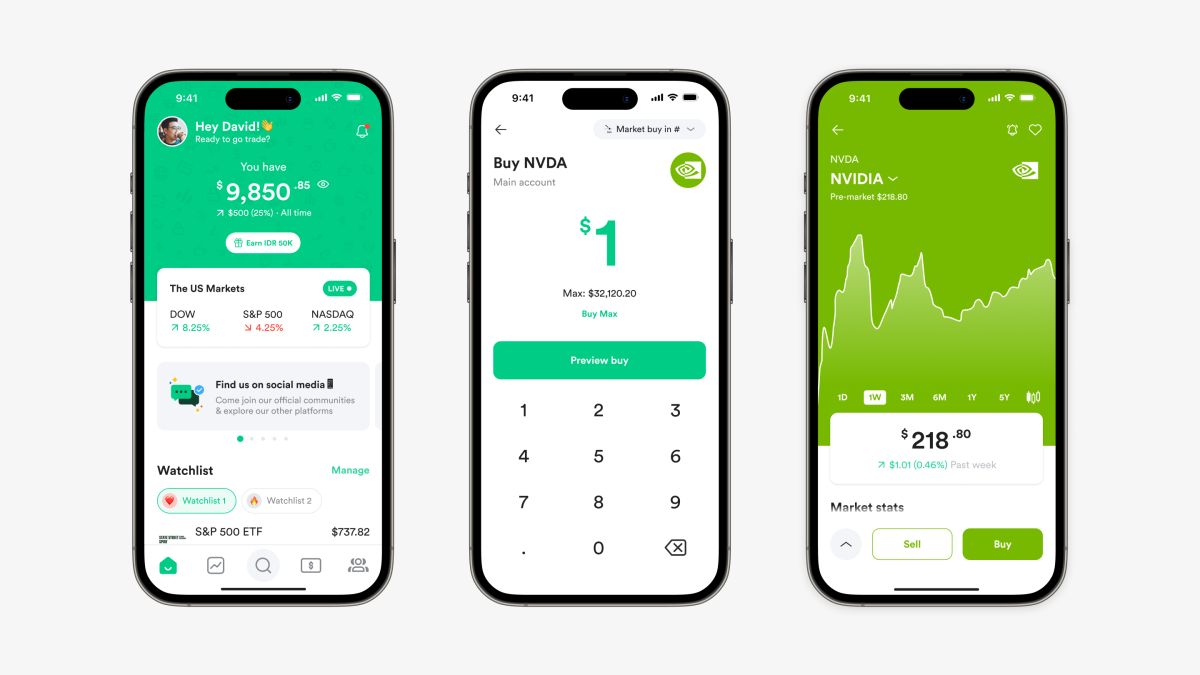
Gotrade gives access to US stocks through fractional shares. You can buy a portion of a share from $1 rather than paying for a whole one. The steps below cover opening an account and placing a first order.
Download and open a Gotrade account.
Add funds into your account.
Search for your desired stocks using its ticker symbol
Specify the purchase amount rather than the number of shares.
Submit your order, and check your position on the portfolio page.
Gotrade requires a minimum deposit of $5 for your first deposit (and subsequent deposits), while individual stock or ETF trades can start as low as $1 using fractional shares, that means the size is set by amount not by share count. The app also includes a Market stats screen feature with TTM valuation ratios such as P/E, price to book, price to sales, ROE, ROA, and ROS, plus an EPS block.
Conclusion
Online trading platforms have made day trading much more accessible for retail investors nowadays but to do day trading it requires capital that you are willing to lose, continuous hours monitoring the market during trading sessions and many realistic outcomes as described above.
Start day trading starting from $1 with fractional shares, so you can adjust your position size to fit your budget each month. Open a Gotrade account when you are ready.