Mostly the stock exchange or market around the world runs just like any other business, opens on monday to friday this includes the US stock market, as one of the largest stock exchanges in the world, retail investors all around the world should adjust it based on their domicile timezone. The US stock market also has holidays on a specific time, then what happens if you buy it outside the market opening hours?
In this article you will get the whole picture of the US stock market hours, when are their holidays and what happens if you trade outside the market hours.
What Are US Stock Market Hours?
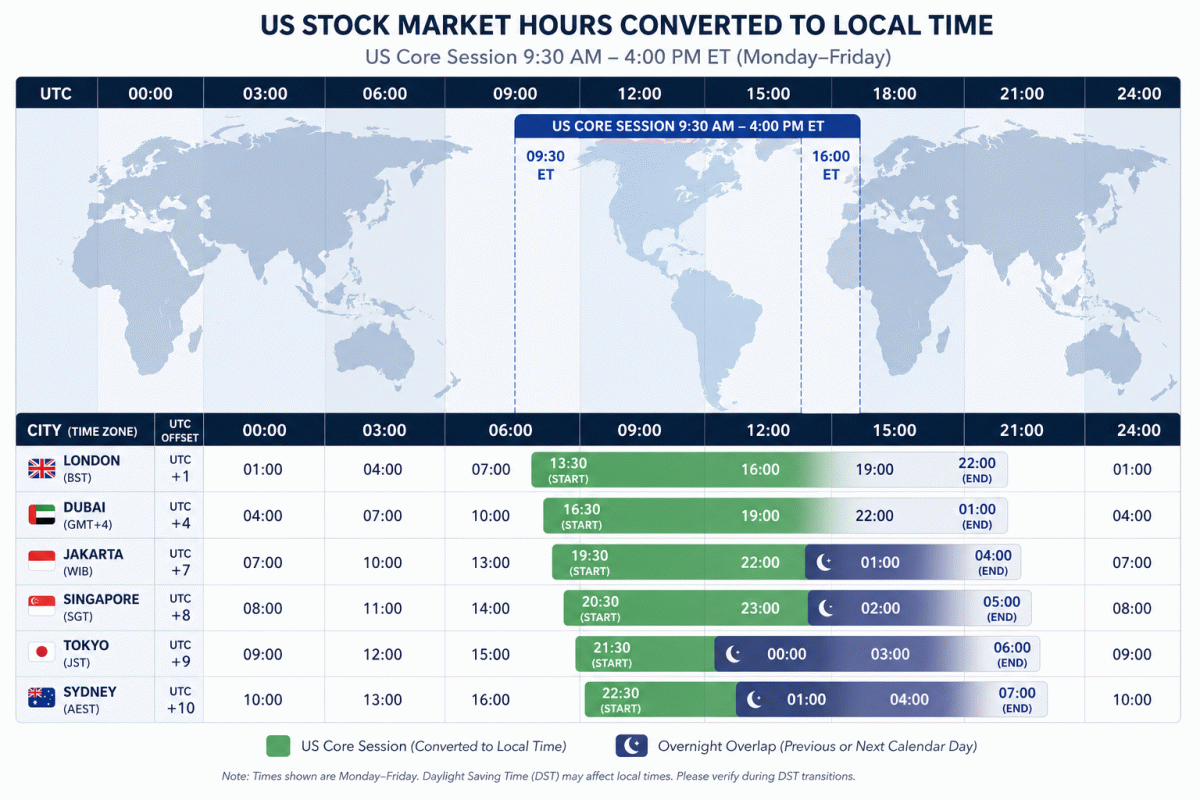
There are two main exchanges in the US stock market and they open from 9:30 a.m. to 4:00 p.m. Most people like to assume all the exchanges opening differ from one another but in fact they are opening and closing at the same time as the stock listed on every exchange trades at the same time.
Exchange | Opens (ET) | Closes (ET) | Days |
NYSE | 9:30 a.m. | 4:00 p.m. | Monday to Friday |
Nasdaq | 9:30 a.m. | 4:00 p.m. | Monday to Friday |
NYSE Arca | 9:30 a.m. | 4:00 p.m. | Monday to Friday |
Cboe (BZX) | 9:30 a.m. | 4:00 p.m. | Monday to Friday |
Source: NYSE Holidays and Trading Hours. All times Eastern Time.
The above table shows all exchanges in the US have the same opening and closing hours, usually an exchange have a closing imbalance period from 3:50 p.m. to 4:00 p.m. this 10 minutes act as mechanism for market transparency, helping institutional traders, market makers, and retail investors digest the supply and demand dynamics before the final closing price. You can look up any US stock and see these windows applied to it.
What Is Pre-Market and After-Hours Trading?
You still can trade stocks and ETFs outside the main trading session using electronic communication networks (ECNs) or alternative trading systems (ATS), this is called extended-hours trading, these sessions are managed by your platform/broker, and vary, so you should choose the platform that suits your trading needs.
Session | Window (ET) | Who sets it | Typical liquidity |
Pre-market | 4:00 a.m. to 9:30 a.m. | Broker, within exchange limits | Thin |
Core session | 9:30 a.m. to 4:00 p.m. | Exchange, fixed | Deepest |
After-hours | 4:00 p.m. to 8:00 p.m. | Broker, within exchange limits | Thin |
There are some differences between these 3 sessions, as the table above is NYSE Arca Early and Late Trading sessions, the widest exchange-operated extended hours.
1. Pre-market trading
During this session the news on the TV, stock price moves in other parts of the world and the company report released before the market open plays a big role.
This session runs from 4:00 a.m. ET at the earliest, up to 9:30 a.m. ET when the core session actually opens. You must check your trading platforms for this availability as this may vary.
2. After-hours trading
Company earnings reports are the most important metric that actually drives this session, the investor reaction to those reports will be shown here. This is also the reason why a stock price can be different at the next morning's open than at the previous close.
This session runs from 4:00 p.m. ET close until 8:00 p.m. ET at the latest. But again, check your platforms for this availability.
3. Overnight and 24-hour trading
The US overnight trading has been in talks for quite some time as per now it is already approved but not yet running. In April 2026 The SEC approved Nasdaq's proposal for a near-23-hour trading day, the session will run from 9:00 p.m. to 4:00 a.m. ET, with a one-hour pause from 8:00 p.m. to 9:00 p.m. ET for clearing and maintenance. While SEC just approved the 24X National Exchange to operate 23 hours each weekday based on their latest announcement.
As all of these depend on the technology which requires a processor to process data simultaneously overnight, and this doesn't change that the core session stays at 9:30 a.m. to 4:00 p.m. ET. You should check for this overnight trading gradually as this information will be updated shortly.
US Stock Market Hours in Your Time Zone
The table converts the 9:30 a.m. to 4:00 p.m. ET core session into local time for six cities, across both halves of the US year.
City | Open, US winter | Close, US winter | Open, US summer | Close, US summer |
London | 14:30 | 21:00 | 14:30 | 21:00 |
Dubai | 18:30 | 01:00 next day | 17:30 | 00:00 next day |
Jakarta | 21:30 | 04:00 next day | 20:30 | 03:00 next day |
Singapore | 22:30 | 05:00 next day | 21:30 | 04:00 next day |
Tokyo | 23:30 | 06:00 next day | 22:30 | 05:00 next day |
Sydney | 01:30 next day | 08:00 next day | 23:30 | 06:00 next day |
Twice a year timeshifts
This timeshift happens because the daylight saving dates vary between countries mostly in the west of the world including the US, EU, and the UK. As Asia does not have daylight saving at all there is no daylight saving.
This gap creates two short windows each year where the usual gap is an hour out. In 2026 they run 8 to 29 March, and 25 October to 1 November. During those weeks an hour schedule gap will occur in London, this is the most common error on this topic.
When Is the US Stock Market Closed and Holiday?
The US stock market is closed every Saturday and Sunday, plus 10 full holidays in 2026.
Holiday | Date in 2026 | Status |
New Year's Day | Thursday, 1 January | Closed |
Martin Luther King, Jr. Day | Monday, 19 January | Closed |
Washington's Birthday | Monday, 16 February | Closed |
Good Friday | Friday, 3 April | Closed |
Memorial Day | Monday, 25 May | Closed |
Juneteenth | Friday, 19 June | Closed |
Independence Day (observed) | Friday, 3 July | Closed |
Labor Day | Monday, 7 September | Closed |
Thanksgiving Day | Thursday, 26 November | Closed |
Day after Thanksgiving | Friday, 27 November | Early close, 1:00 p.m. ET |
Christmas Eve | Thursday, 24 December | Early close, 1:00 p.m. ET |
Christmas Day | Friday, 25 December | Closed |
Source: NYSE Holidays and Trading Hours, as above. Independence Day falls on a Saturday in 2026, so the market closes on Friday 3 July instead.
1. Early close days
There will be two close early days in 2026 due to thanksgiving and Christmas eve holidays, and the session will close at 1:00 p.m. ET. This also affects the extended sessions which will be closed early at 5:00 p.m. ET rather than 8:00 p.m. ET on both days so any traders planning on evening orders have a smaller window than the usual.
2. Unscheduled closures
The market can be closed outside its schedule mostly due to a force majeure, though rarely. The announcement is published on the official exchange page usually the day before. The most notable one was the Hurricane Sandy in October 2012, when US equity markets closed for two consecutive trading days. Severe weather, national days of mourning and system incidents have all produced unscheduled closures.
Why Do Market Hours Matter?
Market hours matter because volume is not spread evenly across the session. The same order behaves differently depending on when it lands.
Volume Concentrates at the Open and Close
Volume concentrates hard at both edges of the day, and most heavily at the close. Cboe research on closing auction dynamics measured the final seconds of the trading day. It found volume spiking to almost five times continuous trading volume on each listing exchange.
The scale of that single event is easy to underestimate. In the first quarter of 2026, NYSE reported its closing auction matching a record 605.5 million shares a day, worth over $43 billion. On 20 March 2026 alone it matched 3.57 billion shares.
After-Hours Prices Do Not Carry Over to the Next Open
A price seen after hours is not a price available at the next open. The two sessions have different participants, and the overnight gap is where that shows up.
None of this is a recommendation about when to place an order. It describes how the day is shaped.
What to Watch When Trading Outside Core Hours
There are 3 risks that are not visible during the core session but carried in extended-hours.
1. Thinner liquidity and wider spreads
Since the extended session have fewer participant and a tighter window the bid-ask spread widens so the price will move more with certain amount of order size during this session. The same exact trade can have a different outcome just because of the timing.
2. Prices can gap at the open
An after-hours price is not a guarantee of the next opening price. The earnings case shows it clearly. A stock can climb several percent in thin after-hours trading on a results release. It can then open somewhere else entirely once the full market weighs in.
3. Order type restrictions
Most trading platforms/brokers have limitations on the order types that work during this session, usually only limit orders are allowed due to a protection reason which occurs because a market order in a thin liquidity session has a large gap between the actual price, forcing the trade to execute at unfavourable prices far from the last quote.
How to Trade US Stocks From Your Time Zone With Gotrade
Here are the steps to trade US stocks from your time zone with Gotrade:
Open an account and complete identity verification.
Fund the account.
Search for the stock by its ticker symbol.
Check whether the market is open before placing an order.
Place the order, or place it ahead of the next session if the market is closed.
You can also check your time zone to align with the US market opening and closing hours.
Conclusion
US stock market hours run from 9:30 a.m. to 4:00 p.m. ET, Monday to Friday but where that window lands for you depends entirely on your time zone and the calendar's twice-yearly shifts. For traders in Jakarta, Singapore, or Tokyo, the core session often falls overnight, which makes checking whether the market is actually open, rather than assuming it, the single most useful habit covered here.
Gotrade gives you access to US stocks through fractional shares, starting from $1. Open a Gotrade account to see how the order screen and market status look from your own time zone.