To learn how to read 13F filing SEC disclosures, start with the most famous: Warren Buffett's Berkshire Hathaway (BRK.B) reported Apple at 22.6% of its book in its Q4 2025 13F.
13Fs are not a shortcut to copying billionaires, but they are the best free window into how the largest institutional pools are positioned at quarter end.
What Is a 13F Filing and Who Must Report
A 13F is a quarterly disclosure that every institutional investment manager with over US$100 million in qualifying US equities must file with the SEC. It lists long positions in US-listed stocks, ETFs, and certain convertible notes.
According to the SEC, managers must file within 45 calendar days of quarter end, putting the 2026 schedule at February 17, May 15, August 14, and November 16.
13Fs show only what is long. Shorts, options hedges, cash levels, foreign-listed stocks, and private holdings are invisible. The signal is real, but partial.
Step-by-Step: How to Find and Read 13F on SEC EDGAR
1. Find a manager on SEC EDGAR
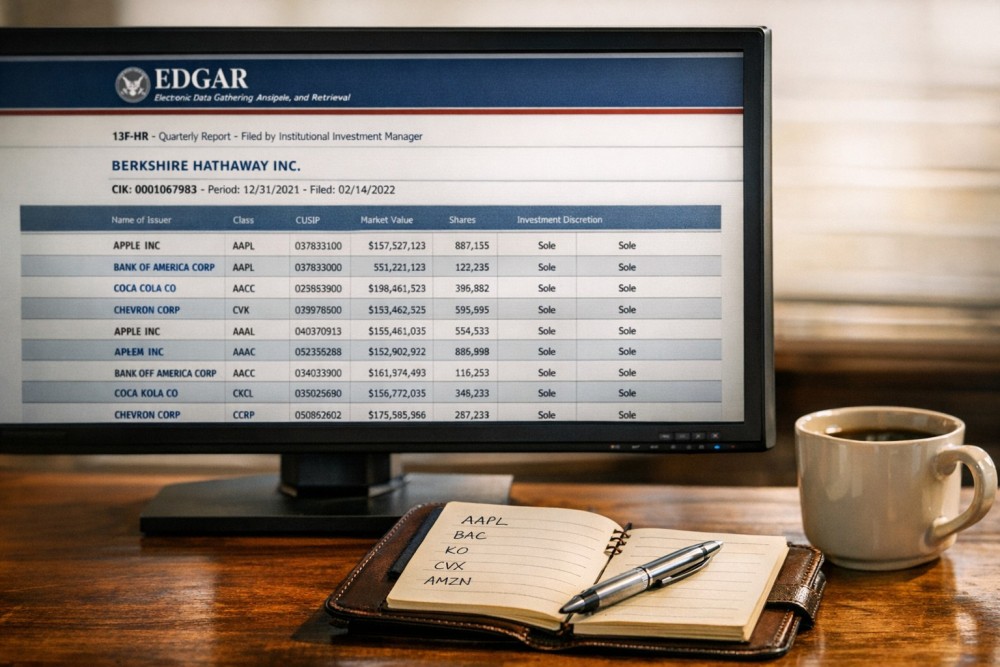
Go to `edgar.sec.gov/cgi-bin/browse-edgar` and search by manager name or CIK (Central Index Key). Berkshire's CIK is 0001067983, Bridgewater's 0001350694, Renaissance's 0001037389. Bookmark the CIK for any fund you track often.
2. Locate the 13F-HR filing
Filter by form type 13F-HR ("holdings report", the full disclosure version). 13F-NT is just a notice pointing to another manager reporting on their behalf.
Click the most recent 13F-HR, then open the information table, the XML document containing the positions.
The table has standard columns: Name of Issuer, Title of Class, CUSIP, Value (in thousands), Shares, and Investment Discretion. Sort by Value descending to see biggest bets first.
"Value" is market value at quarter end, not cost basis. A position that doubled recently will look larger than its conviction weight deserves.
4. Compare quarter over quarter
Pull the previous quarter's 13F-HR and diff the two. What was added, trimmed, and exited tells you more than any single snapshot. WhaleWisdom and 13F.info do this automatically, but doing it manually once teaches you what the data does and does not contain.
Build a watchlist inspired by Berkshire's top holdings and start a fractional position from US$1 in Gotrade App, now!
Top Hedge Fund Portfolios to Watch
1. Berkshire Hathaway
Warren Buffett's Berkshire is the most concentrated and most cited 13F on the market. According to Seeking Alpha, the Q4 2025 top five were Apple (AAPL) at 22.6%, American Express 20.5%, Bank of America 10.4%, Coca-Cola (KO) 10.2%, and Chevron 7.2%.
Roughly 71% of the book sits in five names. Signal value is high precisely because Buffett rarely trades, so any addition or exit carries conviction weight.
Our guide to Warren Buffett's investing principles pairs well here, since the holdings only make sense in the context of his moat-first philosophy.
2. Bridgewater Associates
Ray Dalio's Bridgewater is macro-first, with hundreds of positions across equities and ETFs expressing risk-parity themes. The equity 13F is only a slice of a larger multi-asset book.
Typical positions include broad-market ETFs, emerging-market exposure, Costco (COST), and large-cap staples. Watch the ETF allocations more than single stock picks: they reveal how Bridgewater thinks about regime.
3. Renaissance Technologies
Renaissance is the quant standard-bearer, but the 13F you can read is RIEF, its institutional equities fund. The famous Medallion fund is internal and not disclosed.
Expect hundreds of positions, high turnover, and small weights. The signal is not "Renaissance loves this stock", it is the statistical footprint of a model rebalancing. Treat it as a pattern source.
Limitations: Why You Can't Just Copy Hedge Fund Portfolios
The 45-day lag is the first problem. By the time you see a position, the manager may have already trimmed or exited it.
13Fs also hide hedges. A long shown at 5% might be fully offset by shorts, options, or swaps that never appear on the form.
Non-US stocks, shorts, and cash are all invisible, and for quant books with thousands of names, individual positions carry almost no signal alone.
Finally, you do not share the manager's capital base, tax situation, or risk tolerance. Concentrated portfolios carry higher signal value than sprawling quant books, but neither is a template to copy blindly.
Conclusion
Reading 13Fs well is about pattern recognition, not imitation. The goal is to see how the smartest allocators are tilting their books, then weigh that against your own thesis and risk appetite.
Start with one or two managers whose style matches yours: Buffett if you are a fundamentals investor, Bridgewater if you think macro. Branch out only when you can read each filer's quirks fluently.
Apply the framework today inside your Gotrade watchlist: pick two names from Berkshire's top holdings, check the latest 13F for changes, and start a fractional position from US$1, now!
FAQ
Q: How often are 13F filings released?
A. Every quarter, within 45 calendar days of quarter end, so roughly mid-February, mid-May, mid-August, and mid-November.
Q: Can I see short positions in a 13F?
A. No, 13Fs report only long US equity positions; shorts, options, cash, and non-US holdings are not disclosed.
Q: Where exactly do I find the raw 13F on EDGAR?
A. Search the manager's name or CIK on edgar.sec.gov, filter by form type 13F-HR, and open the information table XML.
Q: Is it worth copying Warren Buffett's top holdings?
A. Using them as a watchlist is reasonable, but blindly copying ignores his capital base, tax position, and 45-day-old data, so size positions to your own risk.