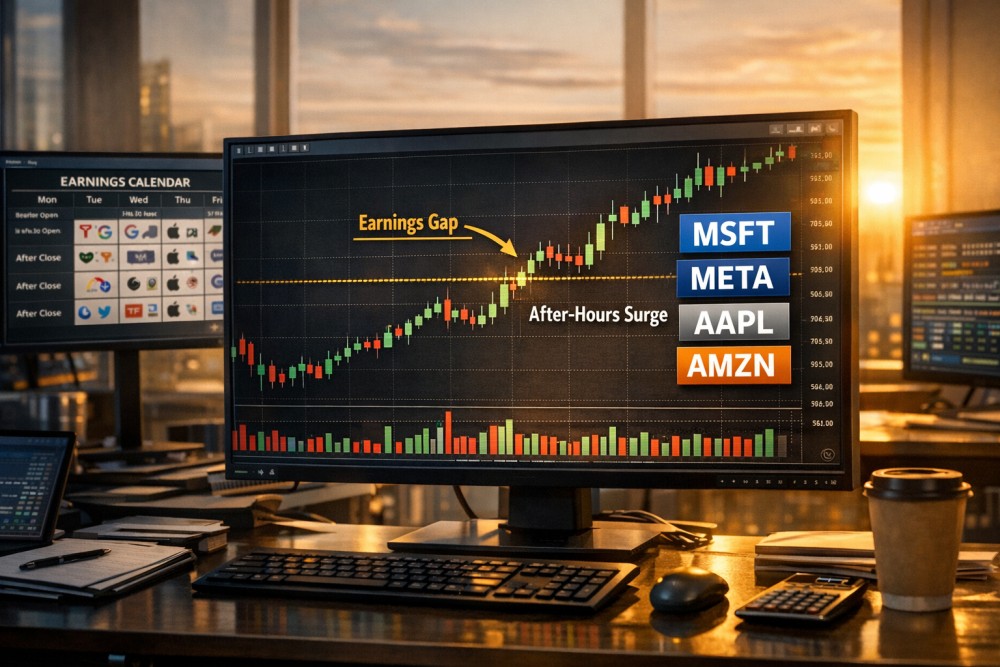
If you hold MSFT, META, AAPL, or AMZN, the post-earnings 48-hour window is where most overtrading damage happens. Two prints land Tuesday after the close, two more on Wednesday.
This is a Mag 7 earnings reaction playbook for shareholders. The goal is to slow down the first 48 hours and avoid the four patterns that quietly cost holders most each quarter.
Why the First 48 Hours After a Print Behave Differently
An earnings print is binary for option traders, multi-stage for shareholders. The after-hours move, the next-day open, and the second session each price in different participants.
The after-hours tape is thin. A single block from a fast-money desk can push Microsoft (MSFT) or Meta (META) several percent on volume that would not move the stock in regular hours.
The next-day open absorbs sell-side revisions. The second session is when long-only funds rebalance, and that is where direction often confirms.
According to research on post-earnings announcement drift, returns drift in the direction of the surprise for at least 60 days. Reacting in hour one fights a trend that takes weeks to develop.
Options-aware holders face a second mechanic. Implied volatility on Mag 7 names is bid up into the print and collapses the morning after, a pattern called vol crush. If you hold covered calls or protective puts on Apple (AAPL) or Amazon (AMZN), IV crush will reprice your option faster than the stock moves.
4 Post-Print Scenarios to Anticipate
Most Mag 7 reactions fall into one of four shapes. Naming the shape early helps avoid inventing a story to justify a trade.
1. Immediate gap up and the urge to take profit
The stock beats, gaps up 4 to 8 percent after-hours, and the temptation is to trim into strength before the move fades. This is the most common overtrade for long-term holders.
The test is whether the beat changes the multi-quarter thesis or just next quarter's print. If only the next quarter, trimming the core sacrifices the slow drift that follows clean beats.
2. Gap down and the urge to average down
A miss or weak guide opens the stock 5 to 10 percent lower, and the reflex is to add at "the discount." This is the mirror image of the first mistake.
According to the CFA Institute's Financial Analysts Journal, drift after a negative surprise is real even in mega-caps. Adding into a fresh gap down often means averaging into more downside before the drift exhausts.
3. AH spike that fades within 4 hours
The stock spikes on the headline EPS beat, then fades as the conference call surfaces softer guidance, margin pressure, or higher capex. By the next morning, half the spike is gone.
Reading the guidance section of the call before reacting saves more capital than any indicator does.
4. Continued post-earnings drift higher
Less famous than a gap, but more profitable for shareholders. The stock prints a clean beat with a raised guide, opens up modestly, then grinds 5 to 15 percent higher over the following weeks.
Selling into day-one strength in a clean drift setup is a regret line in QQQ-heavy portfolios. The index gets dragged higher by the same names you trimmed.
Open Gotrade, pull up your MSFT, META, AAPL, and AMZN positions, and write one sentence per stock on whether your thesis is "next quarter" or "next 12 months." Use that as your 48-hour reaction playbook before the first print drops.
Simple Rules to Avoid Overtrading
The point of a playbook is to remove decisions from the moment of maximum emotion. Two rules cover most of the damage.
1. Wait 30 minutes after AH price discovery
The first 30 minutes after release is dominated by algorithmic reactions to headline EPS. Spreads are wide and the call has not started.
Waiting until 30 minutes into the conference call gives the tape time to absorb guidance and segment surprises. Most regret trades happen in the first 15 minutes, before the call even starts.
2. Re-test whether your investment thesis still holds
Before any reaction trade, re-read the one-line thesis for the position. If your thesis was "Azure growth holding above the high teens," only a print that breaks that line should change your size.
An earnings calendar planning approach works best when paired with this thesis check. If you find yourself retrofitting a new thesis to justify a trade, that is the trade you should not take.
Conclusion
Mag 7 earnings weeks feel urgent, but most of the long-term return shows up in the slow drift after the headlines. The 48 hours after each print is where holders need rules, not reflexes.
Treat MSFT and META Tuesday as the first half of the week, AAPL and AMZN Wednesday as the second, and Friday as the day you reassess.
Open Gotrade, review your Mag 7 positions, and decide which are core and which are tactical. Use fractional shares to size any adjustment in dollars, so one reaction does not reshape your portfolio.
FAQ
How long does post-earnings drift typically last for Mag 7 stocks?
Academic research finds drift in the direction of an earnings surprise lasts roughly 60 days, with a meaningful share clustered around the next quarterly print.
Should I trade options around Mag 7 earnings if I am a long-term holder?
Options bought into the print are exposed to vol crush, which can lose value even when the stock moves your way, so most long-term holders are better served by adjusting the underlying position.
What is the single biggest mistake shareholders make in the first 48 hours?
Reacting to the after-hours headline before the conference call clarifies guidance, which typically means trading on incomplete information at the widest spreads of the week.