Company | Weight |
|---|
NVIDIA | 7.77% |
Apple | 7.72% |
Microsoft | 5.93% |
Amazon | 3.70% |
Alphabet Class A | 2.86% |
Broadcom | 2.33% |
Alphabet Class C | 2.30% |
Meta Platforms | 2.16% |
Tesla | 1.60% |
Eli Lilly | 1.55% |
We can see that bigger companies are getting the bigger part of the fund. The top ten of the 500+ names take up more than a third of the ETF size. This kind of fund attracts investors by being more "stable" than a single stock, because it spreads money across about 500 companies. On the other hand, this top-heavy weighting structure means that a few giant companies will drive most of its movement.
For example: if those ten biggest stocks all fell 10% and everything else stayed flat, the fund would lose about 3.8%. If the other 494 stocks all fell 10% and the top ten stayed flat, the fund would lose about 6.2%. So, ten companies can move the fund more than half as much as the other 494+ together.
How an S&P 500 ETF tracks the index
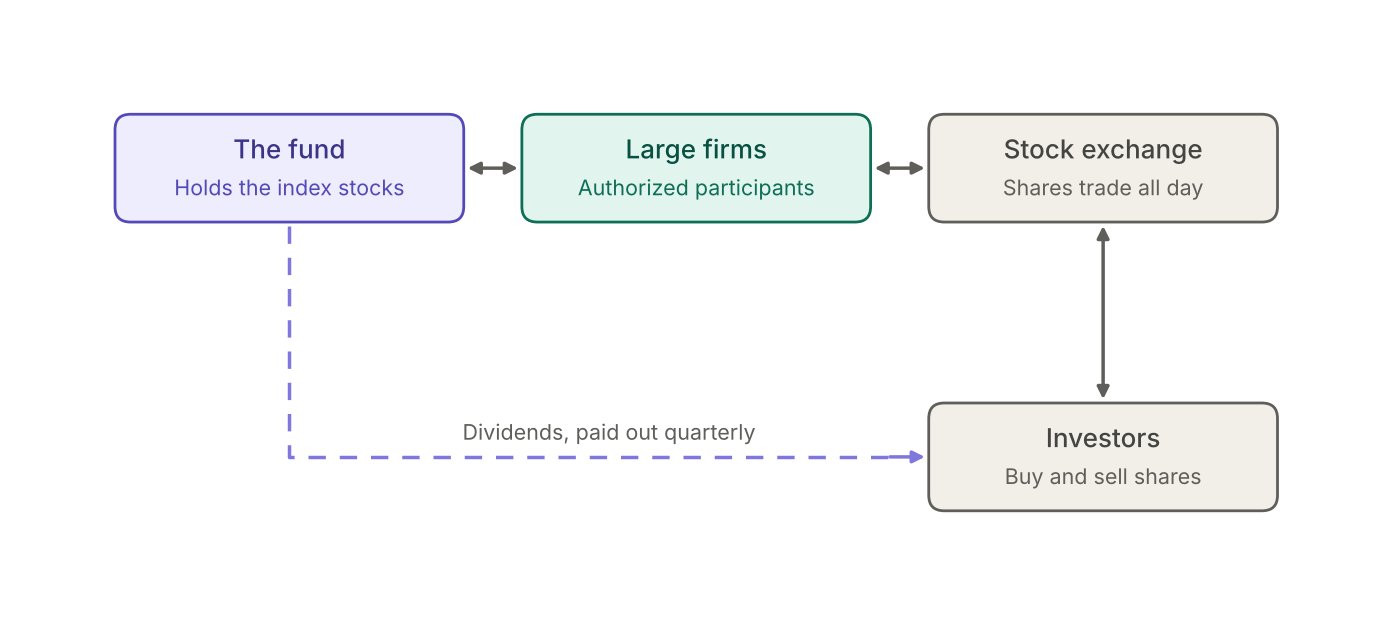
This is how the ETF works. The fund (BlackRock, Vanguard, or whichever you choose) holds the actual stocks that make up an index, in this case the S&P 500. As we discussed before, the first step is for the fund to mirror the S&P 500 index.
Large firms / authorized participants (middle) are the large Wall street brokers who act as intermediaries. When demand for the fund rises, they deliver a basket of stocks to the fund and receive new fund shares. Oppositely when demand falls, they hand back fund shares and receive stocks. These middlemen are needed to keep the system running.
The stock exchange (right) is where the fund’s shares trade throughout the day, just like where you buy an individual stock.
Investors (bottom right) is you and other investors who buy and sell fund shares on the exchange. Notice how the retail investors never deal with the funds directly.
The dashed line (bottom) shows how the funds pass the dividends from companies, to investors.
The main S&P 500 ETFs side by side
There are a few ETFs that follow the index, and each is a little different. You can see the differences below:
| VOO (Vanguard) | IVV (iShares) | SPY (State Street) | SPYM (State Street) |
|---|
Annual fee | 0.03% (Apr 2026) | 0.03% (current prospectus) | 0.0945% gross (Oct 27) | 0.02% gross (Oct 27) |
Fund size | $1,032B (Sep 30) | $881B (Oct 26) | $810B (Oct 26) | $183B (Oct 26) |
Holdings | 505 (Sep 30) | 504 (Oct 23) | 504 (Oct 23) | 505 (Oct 23) |
Top 10 weight | n/a | 37.9% (Oct 23) | 37.9% (Oct 23) | 37.9% (Oct 23) |
Price vs NAV | n/a | 0.02% (Oct 26) | 0.01% (Oct 26) | 0.01% (Oct 26) |
Price of one share (NAV) | n/a | $768.56 (Oct 26) | $765.16 (Oct 26) | $90.06 (Oct 26) |
Legal structure | ETF share class of a Vanguard fund | Open-end fund | Unit investment trust | Open-end fund |
Launched | Sep 7, 2010 | May 15, 2000 | Jan 22, 1993 | Nov 8, 2005 |
Are S&P 500 ETFs the same?
From the table above, we can see that they are pretty much almost identical. They all follow the same index and index provider, having the same holdings and weights, with similar quarterly dividends. The rather minor differences are in the fees, spread, and share prices.
Why funds holding the same stocks return slightly different amounts
Two funds can hold the same stocks, but there may still be some tracking difference. This is the fund’s return minus the index’s return. For example, if the S&P 500 index "returns" 10.00% in a year, a fund which track it may return 9.91%, with −0.09 percentage tracking difference. Why so? There are three reasons:
1. The expense ratio
This is the fee the fund charges for running itself, taken out of the fund’s assets a little each day.
2. How the fund handles dividends
An index calculation assumes those dividends are reinvested right away, while a real fund may hand the dividends to investors.
3. Small trading and timing effects
There are other tiny factors, such as:
Rebalancing: When the index changes its membership or weights, the fund has to trade to match. Those trades involve commissions and slightly imperfect prices.
Sampling: Some funds hold a representative subset of the index’s stocks instead of every one, which creates small deviations.
Cash balances: Funds keep a little cash for redemptions and expenses.
Timing: Trades don’t always happen at the exact prices the index uses.
A study by NYU researchers (Elton, Gruber, Comer and Li) found that from 1993 to 1998, SPY (the first ETF to track the S&P 500) trailed the S&P 500 by about 0.28% a year.
The cost of holding an S&P 500 ETF
Exchange-traded funds still cost money to own, including those that track S&P 500. If you hold one, expect having to pay these expenses:
Yearly fees
The fee in this case is a percentage of what you hold, which is taken out of the fund each day. Look at the numbers for the three rates in the comparison table (SPYM 0.02%, VOO and IVV 0.03%, SPY 0.0945%) below:
Fee rate | Yearly fee on $1,000 | Yearly fee on $10,000 | 20 years on $10,000 |
|---|
0.02% | $0.20 | $2.00 | $40 |
0.03% | $0.30 | $3.00 | $60 |
0.0945% | $0.95 | $9.45 | $189 |
Note: the last column holds the balance flat to keep the arithmetic simple.
The spread
ETF buyers usually face a bid-ask spread, which is the gap between the highest price a buyer will pay and the lowest price a seller will accept.
For example: if the bid is $765.30 and the ask is $765.40, then the spread is $0.10, or about 0.013%. Buying at the ask and selling straight away at the bid would cost you that gap.
ETF price versus NAV
There will be a gap between the ETF price, and net-asset valuation of the companies bundled in the ETF.
NAV (net asset value) is the accounting value of the basket. It’s calculated once a day after markets close: add up the market value of everything the fund holds (plus cash), subtract liabilities and fees owed, and divide by the number of ETF shares outstanding.
ETF price is what the share actually trades for on an exchange right now. Like any stock, it’s set by buyers and sellers throughout the day.
The difference is called a premium if the ETF is priced above NAV or a discount if it's below.
Currency conversion
Remember that these ETFs are priced in US dollars, so if you are converting it to another currency, it will cost you.
Tax on dividends for investors outside the US
The US generally withholds 30% of dividends paid to foreign persons, and taxation will be different according to where you live as an investor.
S&P 500 ETF or S&P 500 index mutual fund?
In practice, both are tracking the same index, and both are pooling investor money. The real difference is in how you buy them, and how they’re taxed.
Trading: Investors buy and sell ETF shares on national securities exchanges at market prices, so you can trade throughout the day. Meanwhile, mutual funds work differently. They must sell and redeem shares at the NAV, calculated after you place your order. The thing is: you don't know this exact price when placing your order. The ETF gives you convenience of knowing the price, but it typically differs a little from its NAV. ETF also costs you the spread.
Accessibility: Some mutual funds set relatively low dollar amounts to buy shares, but others have higher minimums, and ETFs generally let you buy a single share.
Taxes: Mutual fund investors generally owe taxes on any capital gains distributions paid by the fund. ETFs tend to distribute less, and taxed less.
Rule of thumb: If you want to buy in small increments, trade intraday, or hold the fund in a taxable account, an ETF often fits. If you prefer automatic investing, mutual funds work well.
Risks to understand before you invest
Market risk: An S&P 500 fund rises and falls with the index. There is no floor, no guarantee on profit, and no insurance on any loss.
Concentration: The fund covers one country (the US) and only large companies, so it is "concentrated" in that sense.
Currency risk: The funds are priced in US dollars, so a weaker dollar against your currency (if any) will lower your return.
Opportunity cost: Remember that an index fund aims to match the market, not beat it. If this does not match your goals, you may want to look elsewhere.
How to compare S&P 500 ETFs
This is a checklist that might help an investor, and not a recommendation of any fund.
Confirm it tracks the S&P 500 itself, since ticker symbols are easy to confuse. Check that the fund’s stated benchmark is the S&P 500 Index.
Check how dividends are handled: does the fund pays dividends out, or reinvests them? This affects your tax and cash flow.
Look at the spread. The bid-ask spread is the gap between the buy and sell price when you trade, and it varies through the day.
Calculate currency conversion and dividend tax: If you fund your account in another currency, the conversion has a cost. Your home country may tax the dividends and gains as well, so check local rules.
How to buy one
Any broker that offers US-listed ETFs can do it. The usual steps are to open and verify an account, fund it (converting currency if needed), search for the fund’s ticker, and place an order. A limit order lets you set the maximum price you will pay. Many brokers offer fractional shares, so you can invest a set amount, such as $50, instead of the price of one whole share. Availability depends on the broker.
FAQ
What is an S&P 500 ETF, and what does it hold?
It’s a fund that trades like a stock, and holds the shares of ~500 large US companies in the S&P 500.
Which ETFs track the S&P 500?
The big four are VOO (Vanguard), IVV (iShares), SPY (State Street) and SPYM (State Street, formerly SPLG).
VOO vs IVV vs SPY?
All three track the same index. VOO and IVV charge 0.03%, while SPY charges about 0.09%. SPY is the oldest and most heavily traded.
Why does SPY charge more?
It’s mainly a legacy of its older structure, and traders pay for its very deep liquidity.
Why does an ETF return slightly less than the index, and differ from other ETFs?
The index has no costs. The fund pays an annual fee, holds a little cash, and has small trading and tracking differences. Each fund is a little different.
Is SPYM the same fund as SPLG?
Yes. State Street renamed the ticker from SPLG to SPYM effective October 31, 2025. SPYM is not SPY, which is a different fund.
How many companies does it hold, and why not exactly 500?
About 500 companies, but around 503 stocks. Some companies, such as Alphabet, have two share classes in the index, and the index occasionally has more than 500 constituents.
Do they pay dividends?
Yes. They pass on the dividends from the underlying companies, typically quarterly.
How much money do I need, and does share price matter?
Only the price of one share, or less if your broker offers fractional shares. Share prices run from roughly $90 (SPYM) to several hundred dollars (VOO, IVV, SPY). Price per share doesn’t affect returns, but a lower price makes it easier to buy small amounts.
Total cost for an investor outside the US?
Expect four layers:
Fund fee: 0.02–0.09% a year.
Spread: small for these funds, but it applies each time you trade.
Currency: these funds are priced in USD, so converting costs money and your returns move with the exchange rate.
Dividend tax: US-domiciled funds typically face 30% US withholding unless a tax treaty reduces it (often to 15%), and some countries also restrict or tax US-listed ETFs. Irish-domiciled versions (often available in Europe) can be more tax-efficient. Check your country’s rules.
Is an ETF the same as an index fund?
Both track an index. An ETF trades on an exchange all day at a live price, while a traditional index mutual fund trades once a day at the closing price, and may have minimums.
Can you lose money?
Yes. The fund falls when the market falls, and drops of 30% or more have happened. There’s no guarantee you’ll recover, though historically long holding periods have fared better.
Is one S&P 500 ETF enough for diversification?
It’s a good but not complete, since it covers only US large companies. It’s also currently (October 2026) concentrated in a handful of big tech names.