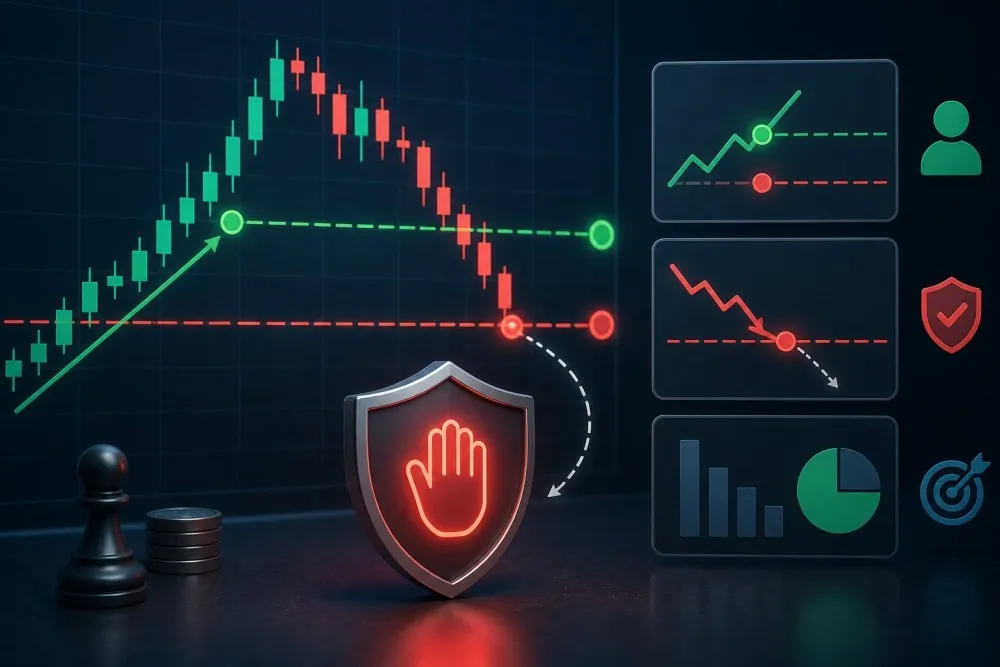
A stop-loss triggers a sale once your stock hits a price you set.
The stop price is a trigger, not the price you are guaranteed.
A trailing stop follows the price up and holds when it falls.
Set stops outside normal daily movement, or noise will trigger them.
Gaps and fast markets can fill stops far below your chosen level.
Stock trading can be beneficial and profitable for you, but it also carries risks and there are no guarantees in stock trading because the financial markets are very natural, unpredictable and can be volatile at certain points. Almost no one knows how far the stock price will rise or fall.
Think of this as your safety net or cushion or even a plan B, because there is always a chance that things might go wrong during your trading and this risk management tool can help you limit your losses when trades don’t go your way. This guide covers how to set one, where to place it, and when it will not do what you expect.
What Is a Stop-Loss Order?
A stop-loss order is an instruction to sell a security once its price reaches a level you specify, called the stop price. It is designed to cap the loss on a position without you watching the screen.
The SEC describes a stop order as an order to buy or sell once the price reaches the stop price. In its investor bulletin on stop orders, it states plainly that when the stop price is reached, the order becomes a market order.
The stop price is a trigger, not a promise
This distinction causes most of the disappointment. Your stop price decides when the order activates, not what price you receive. The SEC warns that the execution price can deviate significantly from the stop price in a fast-moving market. In calm conditions the two are usually close, and in a panic they are not.
Where your stop order actually sits
Most investors assume the exchange is holding their stop. It is not. Under a rule change filed with the SEC, NYSE and NYSE MKT stopped accepting new stop orders and good-till-cancelled orders on February 26, 2016. Existing ones were cancelled.
Brokers still offer stop orders and they hold the instruction on their own systems and send an order to market when your trigger is hit. That adds a step between your price and your fill.
How Does a Stop-Loss Order Work?
Walk through a simple case. You own a stock at $100 and decide you will accept a loss of about 10%. You place a sell stop at $90. Nothing happens while the stock trades above that level. If the stock trades down to $90, your stop triggers and becomes a market order. It sells at the best price available at that moment, which might be $90, $89.80 or considerably lower.
Two rules follow from the mechanics. A sell stop is always placed below the current price, and a buy stop is always placed above it. Buy stops exist for short positions and for entries on a breakout. The logic is the same in reverse.
Stop-Loss, Stop-Limit or Trailing Stop: What Is the Difference?
The three order types solve different problems, and mixing them up is a common beginner error.
Order type
What happens when triggered
Main trade-off
Stop (stop-loss)
Becomes a market order and sells at the next available price
Execution is likely, but the price is not controlled
Stop-limit
Becomes a limit order at your limit price or better
Price is controlled, but the order may never fill
Trailing stop
Stop price follows the market up, then triggers a market order
Locks in gains, but normal swings can trigger it
How a trailing stop works
A trailing stop is set as a distance below the market price, either a percentage or a dollar amount, rather than a fixed level.
Say you own a stock at $100 with a 10% trailing stop. The trigger starts at $90. If the stock rises to $130, the trigger rises with it to $117. If the stock then falls, the trigger stays at $117 rather than falling back. The trigger only moves in your favour, which is why traders use trailing stops to protect gains rather than just to cap losses.
The stop-limit trade-off
A stop-limit avoids selling at a terrible price, because it will not execute below your limit. The SEC notes the same feature is its weakness: the limit price may prevent the order from being executed at all. In a sharp fall that is the worst outcome. The stock drops through your limit, the order sits unfilled, and you still hold the position.
Where Should You Set a Stop-Loss?
There is no correct distance. Four approaches are in common use, and each answers a different question.
Method
How it works
Best suited to
Fixed percentage
A set distance below entry, such as 8% or 15%
Simplicity and consistency across positions
Volatility-based
A multiple of the stock's typical daily range
Avoiding exits caused by normal movement
Chart level
Just below a recent low or support area
Traders working from price structure
Risk-based
Set so the loss equals a fixed share of your portfolio
Controlling total risk rather than per-trade risk
The risk-based method deserves attention because it works backwards from what you can afford. Decide the most you will lose on one position, say 1% of your portfolio. Your position size and stop distance then have to multiply out to that number. On a $10,000 portfolio, 1% is $100. A stop 10% below entry means a position of about $1,000, while a stop 20% below entry means about $500.
Stop-loss position size calculator
One principle applies to every method. A stop placed inside a stock's normal daily range will be hit by noise, not by anything meaningful. Volatile stocks therefore need wider stops or smaller positions. A semiconductor stock and a utility do not deserve the same 5% stop.
What Can Go Wrong With a Stop-Loss?
Three failure modes matter, and all three appear in the same conditions: a fast, one-directional market.
1. Gaps jump over your stop
Stocks do not trade continuously. If a company reports bad news after the close, the next trade can happen well below your stop price. Your order still triggers, but it executes wherever the market opens. A stop at $90 is no protection if the stock reopens at $72.
2. Fast markets produce bad fills
August 24, 2015 is the standard example. US markets opened sharply lower and prices moved faster than order books could absorb.
The SEC's staff research note on that day counted 1,058 volatility halts in 327 exchange-traded products and 220 halts in 144 other securities. It also found that 19.2% of exchange-traded products declined by 20% or more, while 63.4% fell by less than 10%. Stops triggered in the first group sold into prices that recovered within the hour.
3. Whipsaw exits
A stop that is too tight converts temporary volatility into a permanent loss. You sell at the bottom of a normal pullback, and the stock recovers without you and each whipsaw also costs the spread and any fees on both the exit and a re-entry. Repeated often, that erodes returns even when the stops looked sensible.
Should Long-Term Investors Use Stop-Losses?
Often not, and that answer separates trading from investing. A stop-loss enforces a price-based exit. If your reason for owning a company is its business over years, a 15% price drop is not new information about the business.
Index-tracking positions are the clearest case. Selling a broad market ETF after a market-wide fall locks in the decline and takes you out of the recovery. Long-term investors usually get better protection from three other habits.
Position sizing limits what any single holding can do to the portfolio. Diversification spreads the risk across companies and sectors. Regular review against the company's actual results gives you an exit reason based on the business rather than the price.
Stops fit best where the holding period is short and the exit rule is mechanical by design. That is trading, and it comes with its own odds.
How Do You Place a Stop-Loss Order?
The mechanics are quick once the decisions are made.
Decide the maximum loss you will accept on the position, in money rather than percent.
Choose the method for placing the stop from the table above.
Check the stock's normal daily range so your stop sits outside the noise.
Confirm which order types your broker supports, since availability varies by firm.
Place the order and note its expiry, because day orders and longer-dated orders behave differently.
Step 4 matters more than it looks. The SEC notes these order types may not be available through all brokerage firms. Gotrade offers fractional shares from $1, which makes step 1 easier to honour. You can size a position to the loss you are willing to take rather than to the price of one share.
Conclusion
Before setting your next stop, work out the position size that makes the loss acceptable, then place the stop outside the stock's normal daily movement. Those two steps help avoid the most common bad outcomes, and they matter more than which order type you pick, since a stop-loss only executes at the best available price once triggered, not the price you set then decide honestly whether your holding period suits a price-based exit at all.
This content is for educational purposes only and is not investment advice or a recommendation to use any order type or strategy. Investing carries risk, including the possible loss of principal. Order types, availability and behaviour vary by broker, and stop orders do not guarantee an execution price.
Gotrade is the trading name of Gotrade Securities Inc., which is registered with and supervised by the Labuan Financial Services Authority (LFSA). This content is for educational purposes only and does not constitute financial advice. Always do your own research (DYOR) before investing.
Muhammad Zhafran Tsany is a digital market with over years of experience, covering personal finance content since 2024, including stock market basics and beginner investing strategy for Rankia Indonesia. He holds a Bachelor of Business in Digital Business from Universitas Pendidikan Indonesia.