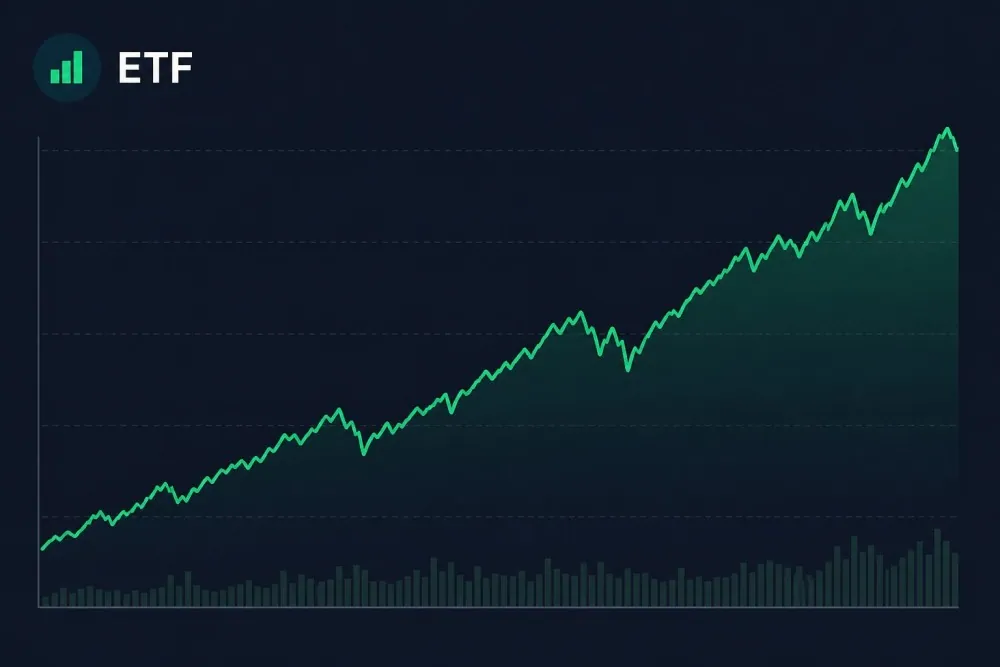
An ETF holds many investments and trades on an exchange like a single stock.
Fees sit inside the fund as an expense ratio.
Two ETFs on one theme can track different indexes and hold different companies.
An ETF, or exchange-traded fund, is a basket of investments that trades on a stock exchange like a single stock. One share gives you a slice of everything the fund holds. US-listed ETFs held $15.70 trillion in assets in June 2026, according to the Investment Company Institute. That is the definition. The part that decides what you actually own is the basket.
A few ETFs can have the same label but different stock list and different weightings approach for a different fee. This article uses them to show the differences that those ETFs make
What Is an ETF?
ETFs have been available in the United States for more than 30 years. The first one, now called the State Street SPDR S&P 500 ETF Trust, listed on January 22, 1993 and tracks the S&P 500.
An exchange-traded fund is a pooled investment fund whose shares are listed and traded on a stock exchange, basically it is a mutual fund but traded on the stock exchange just like a stock. ETFs own their underlying assets, usually stocks, but they can also be bonds, currencies or commodities, and you own a share of the fund if you purchase the ETFs.
This financial instrument has been available for a long time, and has been traded in the US for more than 30 years, the first ETF is the State Street SPDR S&P 500 ETF Trust, listed on January 22, 1993 and tracks the S&P 500.
What you own when you buy one share of ETF
You own a proportional claim on the fund's holdings, not the holdings themselves. A share of an S&P 500 ETF gives you exposure to around 500 companies at once. You do not receive voting rights in those companies, because the fund holds the shares. The fund publishes its holdings, usually every day. Nothing about the basket has to be guessed.
Most ETFs work by tracking an index. The fund buys the securities in that index at roughly the index weights, then lists its own shares for trading.
Three mechanics matter for a beginner are;
1. The index sets the holdings
An index is a published list of securities and their weights, maintained by an index provider rather than by the fund manager. The fund's job is to match the list, not to pick winners. That is why these funds are called passive.
Actively managed ETFs also exist, where a manager chooses the holdings. They are a minority of the market and usually charge more.
2. Market-cap weighting concentrates the top
Most index ETFs weight holdings by market value, so the largest companies take the largest share of the fund. The effect is easy to underestimate. In the iShares Semiconductor ETF, the ten largest holdings made up 61.29% of the fund as of June 30, 2026. A fund holding 30 companies can still be driven mostly by ten of them.
3. The share price tracks the value of the basket
Each fund calculates a net asset value, which is the value of its holdings divided by the shares outstanding.The market price during the day can sit slightly above or below that value. Large institutions called authorised participants create and redeem blocks of shares, which keeps the two close in normal conditions.
In stressed markets that gap can widen. It is a normal feature of the structure, disclosed in every fund prospectus. The size of that gap depends on what the fund holds. A study by Petajisto (2017) examined 1,008 US-listed ETFs between 2007 and 2010. Diversified US equity funds traded within about one basis point of net asset value on average. Funds holding international or less liquid securities drifted further. High-yield bond ETFs in that sample averaged a premium of 105 basis points.
What Are the Main Types of ETFs?
ETFs are grouped by what sits inside the basket. Five categories cover most of what a beginner will meet.
Type
What it holds
Typical use
Broad market equity
Hundreds of stocks across an index such as the S&P 500
Core exposure to a whole market
Sector or thematic
Companies in one industry, such as semiconductors
Targeted exposure to a single theme
Bond
Government or corporate debt
Income and lower volatility than equities
International
Companies listed outside the home market
Exposure to other economies
Commodity
Physical assets or futures, such as gold
Exposure to raw material prices
The size of each group is uneven. ICI reported that large-cap domestic equity ETFs held $5.0 trillion at the end of 2025, or 38% of all ETF assets. Bond ETFs held $2.2 trillion over the same period, or 17%. Broad equity funds remain the centre of the market, and sector funds sit at the end of it.
What Is the Difference Between an ETF and a Stock?
A stock is a share in one company. An ETF is a share in a fund that holds many companies. Both trade the same way, through the same order types, during the same hours.
Feature
Single stock
ETF
What you own
Part of one company
A share of a fund holding many securities
Diversification
None by itself
Built in, though it varies by fund
Ongoing fee
None
An expense ratio, charged inside the fund
Company risk
One bad quarter can hit the whole position
Spread across holdings, unless the fund is concentrated
Voting rights
Yes, as a shareholder
No, the fund votes the underlying shares
Income
Dividends, if the company pays them
Distributions, if the holdings pay dividends
Diversification is the real difference, and it is a spectrum rather than a switch.
Owning Nvidia alone is concentrated in one company. Owning a semiconductor ETF is concentrated in one industry. Owning an S&P 500 fund spreads across eleven sectors.
Neither approach replaces the other. Many investors hold a broad fund as a base and add individual US stocks around it.
How Much Does an ETF Cost?
The main ongoing cost is the expense ratio, an annual percentage deducted from the fund's assets. You never receive a bill, because the charge is taken inside the fund.
Fees vary widely by fund type. Broad index funds sit at the bottom of the range and sector funds toward the middle.
Fund
Expense ratio
Annual cost on $1,000
State Street SPDR S&P 500 ETF Trust (SPY)
0.0945%
About $0.95
iShares Semiconductor ETF (SOXX)
0.34%
About $3.40
VanEck Semiconductor ETF (SMH)
0.35%
About $3.50
Expense ratios from each fund's own page and fact sheet, current as of September 2026. Annual cost is the ratio applied to a $1,000 holding, before any trading costs.
Two other costs sit outside the expense ratio. The bid-ask spread is the gap between the buying and selling price at the moment you trade, and brokerage fees depend on your broker.
Spreads are usually narrow on large, heavily traded funds and wider on small or niche ones.
Do ETFs Pay Dividends?
Yes, when the fund's holdings pay dividends. The fund collects those dividends and passes them to shareholders as distributions, usually quarterly.
The amount depends entirely on what the fund holds. Semiconductor funds are a useful example of how small that can be. The iShares Semiconductor ETF distributes quarterly, but its 30-day SEC yield was 0.01% as of June 30, 2026.
Chipmakers reinvest most of their cash rather than paying it out, so a fund tracking them produces almost no income. A broad market fund holding banks, energy producers and consumer companies pays considerably more. If income matters to you, read the fund's yield figure before buying, not the category label.
SMH or SOXX: How Do Two Similar ETFs Differ?
Both funds hold US-listed semiconductor companies. They are the two most recognised names in the category, and they are not interchangeable.
Feature
SMH
SOXX
Issuer
VanEck
iShares (BlackRock)
Index tracked
MarketVector US Listed Semiconductor 25
NYSE Semiconductor Index
Holdings
Around 25 companies
30 companies
Expense ratio
0.35%
0.34%
Net assets
$66.84 billion
$47.82 billion
Launched
December 20, 2011
July 10, 2001
SMH figures from VanEck's fund page as of September 16, 2026. SOXX figures from the iShares fact sheet as of June 30, 2026. The fees are nearly identical. The indexes are not, and that is where the funds separate. SOXX held Micron and AMD as its two largest positions on June 30, 2026, at 8.54% and 8.09%. A fund weighted differently would have produced a different return from the same industry.
The lesson generalises when two ETFs share a theme, compare the index, the number of holdings and the top-ten weight before comparing the fee.Here is a quick simulation if you invested $1000
SMH vs SOXX comparison
What Are the Risks of Buying an ETF?
An ETF removes single-company risk. It does not remove market risk, and some funds add risks of their own.
1. The market itself can fall
A fund that tracks an index falls when the index falls. Diversification spreads risk across holdings, it does not cancel it. Broad market funds have had losing years, and every fund prospectus states that you can lose principal.
2. Concentration inside the basket
A narrow fund can behave more like a sector bet than a diversified holding. The iShares Semiconductor ETF reported a three-year beta of 2.00 against the S&P 500 as of June 30, 2026. Its three-year standard deviation was 35.47%.
A beta of 2.00 means the fund has tended to move about twice as much as the broad market, in both directions.
3. Tracking difference and fees
A fund returns the index performance minus its costs, so it will normally lag the index it tracks by a small margin.
Over a long holding period, a higher expense ratio compounds against you. That is the practical argument for checking the fee on every fund you compare.
How Do You Buy an ETF?
You buy an ETF through a brokerage account, using the same order screen you would use for a stock. The steps are short.
Open a brokerage account and complete identity verification.
Fund the account.
Decide what exposure you want, broad market or a specific sector.
Search the ticker and check the expense ratio, the number of holdings and the top-ten weight.
Choose an amount and place the order.
For the holdings list and the expense ratio, read the issuer's fact sheet, which is free on the fund's own website.
Conclusion
The next step is comparing two funds that sound the same. Pick a theme you understand, open the fact sheet for two ETFs that track it, and read the holdings and fees side by side. That habit takes a few minutes and it is what separates picking an exposure from picking a ticker.
This content is for educational purposes only and is not investment advice or a recommendation to buy or sell any security. Investing carries risk, including the possible loss of principal. Fund figures are taken from issuer documents on the dates stated and change over time
Gotrade is the trading name of Gotrade Securities Inc., which is registered with and supervised by the Labuan Financial Services Authority (LFSA). This content is for educational purposes only and does not constitute financial advice. Always do your own research (DYOR) before investing.
Muhammad Zhafran Tsany is a digital market with over years of experience, covering personal finance content since 2024, including stock market basics and beginner investing strategy for Rankia Indonesia. He holds a Bachelor of Business in Digital Business from Universitas Pendidikan Indonesia.