
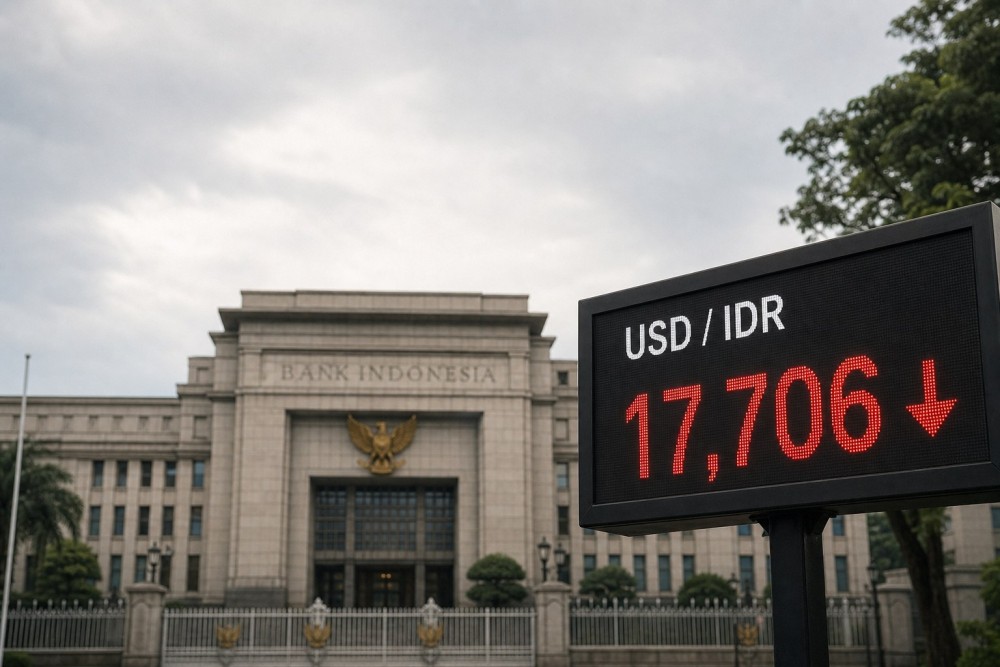
Gotrade News - Indonesia's rupiah touched 17,706 per US dollar on May 20, 2026, marking an all-time low for the emerging-market currency. Bank Indonesia's foreign exchange reserves slid $10.27 billion between December 2025 and April 2026.
The slide has fueled expectations that Bank Indonesia will raise its benchmark policy rate by 25 basis points to 5% at the May 19-20 board meeting. Currency pressure is also leaking into the real economy, particularly import-reliant technology firms.
Key Takeaways
- The Indonesian rupiah (IDR) hit an all-time low of 17,706 per USD on May 20, 2026.
- Forex reserves fell $10.27 billion to $146.20 billion by end-April 2026 amid central bank intervention.
- Bank Indonesia is widely expected to lift its policy rate 25bps to 5% to defend the currency.
Reserve Erosion And Policy Response
According to Kompas, reserves at Bank Indonesia (BI), the country's central bank, fell from $156.47 billion in December 2025 to $146.20 billion by April 2026. The $10.27 billion drawdown reflects sustained intervention to stabilize the rupiah.
To pull foreign capital back in, BI lifted the yield on its Rupiah Securities (SRBI) from roughly 4.9% in early 2026 to 6.5% by early May. That tactic drew net foreign inflows of around 78 trillion rupiah (about $4.4 billion) through April.
The central bank's repo rate also nudged higher to 5.1%, signaling tighter liquidity ahead of the policy meeting. Markets read the shift as preparation for a formal rate hike.
Syuhada Arief, Senior Portfolio Manager for Fixed Income at Manulife Asset Management Indonesia, said BI has room to lift the benchmark rate to 5%. Nafan Aji Gusta, Senior Market Analyst at Mirae Asset Sekuritas, also projected a 25 basis point hike at this week's board of governors meeting.
Investors tracking Indonesia equity sensitivity to currency moves can watch EIDO, the iShares MSCI Indonesia ETF and the most direct US-listed proxy. Dollar strength against emerging-market peers is reflected in UUP, the Invesco DB US Dollar Bullish Fund.
Why 2026 Is Not 1998
As reported by Kompas, Indonesian officials stressed that current conditions differ materially from the 1998 Asian financial crisis. Headline inflation sat at 2.41% in April 2026, far below the roughly 77% print during that crisis.
Finance Minister Purbaya Yudhi Sadewa said the fundamentals today are not comparable to 1998. The earlier crisis combined policy missteps with political instability, while 2026 growth remains intact.
Gross domestic product expanded 5.61% year-on-year in Q1 2026, against a roughly 13% contraction in 1998. Bank capital adequacy stands at a healthy 25.83%, compared with negative readings during the crisis era.
The 1998 reference matters for emerging-market investors gauging contagion risk across Southeast Asia. The comparison helps frame whether currency stress is cyclical or structural.
Per Bloomberg Technoz, Indonesia's domestic IT sector is directly exposed because it relies heavily on imported equipment. Laptops, servers, networking gear, and electronic components have all seen procurement costs swell.
Jerry M Swandy, chairman of Apjatel (the Indonesian telecommunications infrastructure association), said the weaker rupiah automatically raises procurement cost pressure. Margins at telecom and IT service providers could compress if hedging strategies are not deployed quickly.
Long-duration sensitivity to global yields makes TLT, the iShares 20+ Year Treasury Bond ETF, a useful benchmark for tracking the global rate backdrop. Markets now await the BI board verdict as a near-term catalyst for the rupiah and Indonesian risk assets.