
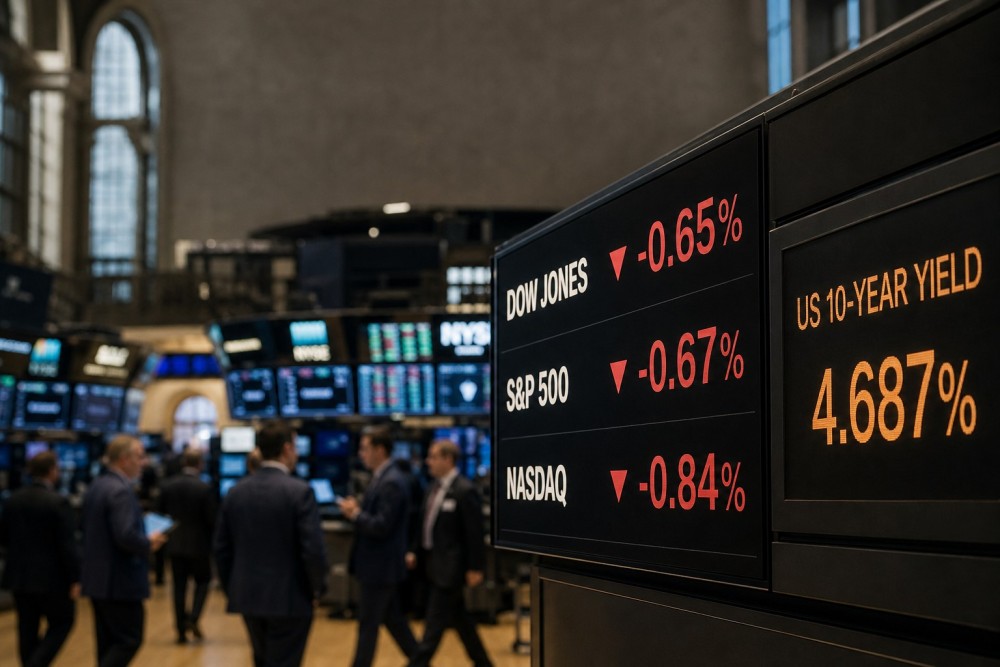
Gotrade News - Wall Street's major indexes slid Monday as a surge in U.S. Treasury yields rattled equity markets. The Dow Jones fell 322.24 points, or 0.65%, to 49,363.88, the S&P 500 dropped 0.67% to 7,353.61, and the Nasdaq lost 0.84% to 25,870.71.
The 10-year Treasury yield climbed to 4.687%, its highest since January 2025, before easing to 4.66%. Lingering uncertainty over a U.S.-Iran de-escalation kept Brent crude above $110 a barrel, amplifying selling pressure on risk assets.
Key Takeaways
- The S&P 500 and Nasdaq posted a third straight decline, led by technology and materials weakness.
- The 10-year Treasury yield touched 4.687%, the highest reading since January 2025.
- Geopolitical tensions kept Brent crude above $110 per barrel, weighing on broad sentiment.
What Drove the Selloff
According to Kompas, the spike in the 10-year Treasury yield to 4.687% was the principal trigger for Monday's broad equity selloff. Higher long-end yields raised expectations of tighter monetary policy and compressed valuations on growth stocks.
Technology shares bore the brunt of the move given their sensitivity to rates, while the materials sector dropped 2.3%. Investors seeking broad index exposure can track the SPDR S&P 500 ETF (SPY) and the Invesco QQQ Trust (QQQ), both of which mirrored the pullback.
As reported by kumparan, decliners outpaced advancers by a ratio of 2.66 to 1 on the NYSE. Defensive health care names were a rare bright spot, gaining 1.1% amid the broader risk-off tone.
Michael James of Rosenblatt Securities said there was nothing constructive enough to convince traders a ceasefire was near. Vice President JD Vance earlier described progress toward peace, but markets have yet to see concrete evidence of a deal.
Garrett Melson of Natixis Investment Managers flagged rate volatility as an added headwind for global risk assets. Long-end yield swings remained the dominant focus for institutional traders throughout Monday's New York session.
Risks Still Hanging Over Markets
Per Kabar Bursa, the 30-year Treasury yield approached 5.2%, its highest level since 2007. Investors worry a second inflation wave could force the Federal Reserve to keep policy restrictive for longer than previously expected.
Asian markets followed Wall Street lower, with the Nikkei 225 sliding 1.64% to 59,557.02 in early Tuesday trade. The WSJ Dollar Index rose 0.35% to 95.99 as investors rotated into safe-haven assets amid geopolitical uncertainty.
WTI crude traded at $107.77 a barrel while Brent held at $110.85 a barrel during the session. The Middle East risk premium continues to make any near-term cooling in global inflation pressures difficult to engineer.
China's industrial production growth slowed to 4.1% year-on-year from 5.7% in March, adding to global growth concerns. The macro backdrop reinforced demand for long-duration bonds tracked by the iShares 20+ Year Treasury Bond ETF (TLT).
Investors now await U.S. inflation data and remarks from Fed officials this week for clues on the rate path. Volatility is expected to remain elevated until Treasury yields establish a new stable trading range.