

Gotrade News - The AI investment cycle hit two distinct inflection points on Monday (5/4). AI chipmaker Cerebras filed for a $3.5 billion U.S. IPO at a $24.5 billion valuation, while Apple's first-half FY2026 capital expenditure of $4.3 billion exposed a widening gap between the iPhone maker and rival hyperscalers.
The Cerebras filing positions wafer-scale chip architecture as a direct challenger to NVIDIA's data-center dominance. The Apple capex disclosure reframes the AI capital intensity question as a strategy choice rather than a budget constraint.
Key Takeaways
- Cerebras targets a $3.5 billion IPO at a $24.5 billion valuation, up 6.5% from $23 billion in February, with chips housing 2.6 trillion transistors per CS-2 system versus NVIDIA (NVDA) H100 at roughly 80 billion.
- Apple (AAPL) H1 FY2026 capex of $4.3 billion looks like a rounding error next to Amazon (AMZN) at $200 billion expected for 2026, Alphabet (GOOGL) at $180-190 billion, and Meta at $125-145 billion.
- Apple's edge-AI strategy with A19 Pro chips and an Alphabet-Gemini Siri partnership signals a different competitive posture than the data-center buildout race led by Microsoft (MSFT) and Amazon.
Cerebras IPO: Wafer-Scale Bet
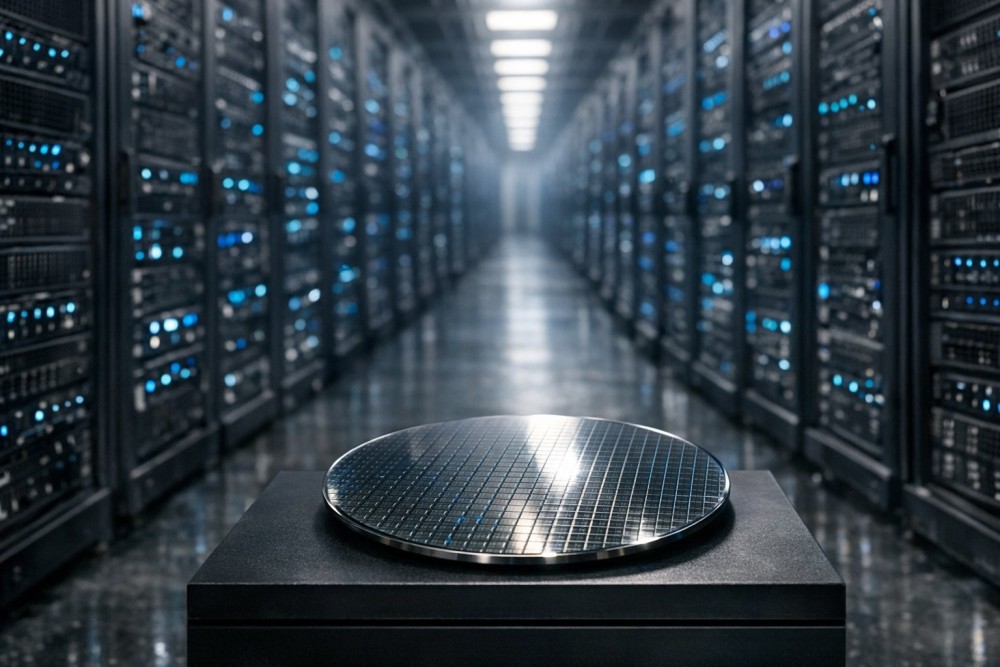
According to techbuzz.ai, Cerebras's CS-2 system holds 2.6 trillion transistors compared to NVIDIA (NVDA) H100 at approximately 80 billion. The wafer-scale design enables faster data movement during AI training, though manufacturing complexity remains a structural challenge.
NVIDIA still controls an estimated 80-90% of the AI training chip market. Cerebras has so far attracted pharmaceutical companies and research institutions as customers, with cloud giants developing custom silicon as a competing pressure point.
Apple's $4.3B vs Hyperscaler $100B+
According to The Motley Fool, Apple (AAPL) H1 FY2026 capex totaled only $4.3 billion. The board separately authorized an additional $100 billion in share repurchases and lifted the dividend by 4%.
Apple's strategy bets on edge computing through A19 and A19 Pro chips with built-in neural accelerators. A new partnership with Alphabet (GOOGL) will power an upcoming Siri version using Gemini.
The AI Capex Spread
The gap between Apple and the hyperscalers is now structural. Amazon (AMZN) is on pace for $200 billion in 2026 capex, Alphabet (GOOGL) for $180-190 billion, and Meta for $125-145 billion.
Microsoft (MSFT) remains the largest backer of OpenAI and a primary buyer of NVIDIA capacity. The hyperscaler capex pool is the demand engine that an IPO like Cerebras is trying to capture a sliver of.
What This Means for Investors
The AI trade now splits into two clean tracks. Track one is hyperscaler capex demand flowing to chip and infrastructure suppliers like NVIDIA (NVDA) and challengers like Cerebras.
Track two is platform monetization, where Apple (AAPL) and software-led players capture downstream value without owning the data centers. Investors tracking the AI theme should watch the Cerebras S-1 financials and any updated Apple capex guidance for confirmation of which track compounds faster.
Sources
The Motley Fool, Apple Just Gave Investors a $100 Billion Reason to Rethink the AI Spending Race, 2026.
techbuzz.ai, AI chipmaker Cerebras targets $3.5 billion raise in IPO, 2026.